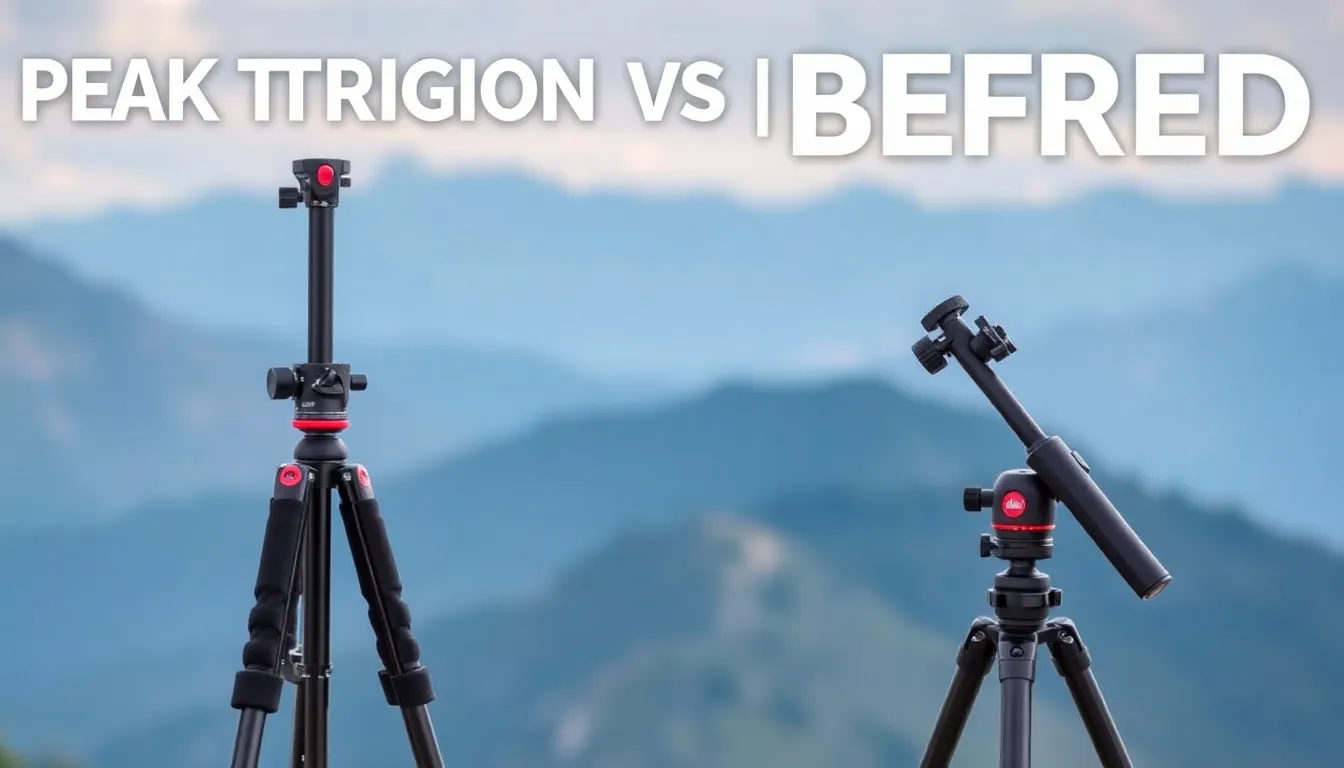
Peak Design Travel Tripod vs Manfrotto Befree — Which Is Worth the Money?
I’ve stood at dawn on countless ridgelines, watching light creep across distant valleys, with nothing but a tripod between me and the shot that matters. Over the years, I’ve learned that a tripod isn’t just another piece of gear—it’s your foundation. Literally. Which is why choosing between the Peak Design Travel Tripod and the Manfrotto Befree Advanced isn’t a casual decision.
Both of these tripods have earned their reputations in the field. Both pack down small, both travel well, and both are priced at a level that says “serious” without saying “reckless.” But they’re different beasts, and understanding those differences matters when you’re planning your next expedition.
The Peak Design: Engineered Precision
The Peak Design Travel Tripod feels like it was designed by someone who understands the exact moment of frustration—the moment when you’re fumbling with leg locks in fading light, or trying to adjust your center column with numb fingers.
Peak Design’s approach is all about refinement. The twist-lock legs have a satisfying precision to them. There’s no play, no wiggling once they’re set. The ball head integration is seamless; everything works as a cohesive system. When I first set it up in the field—on a rocky slope near treeline, actually—I appreciated how intentional every detail felt.
The compactness is genuine. At about 2 pounds and 16 inches when folded, this tripod disappears into a backpack. I’ve hiked 8+ miles with this strapped to my pack without thinking about it much. That matters when you’re climbing toward alpine light.
But here’s what I’ve noticed: Peak Design charges a premium for that integration and polish. This isn’t a budget option. You’re paying for design thoughtfulness, and you’re paying for the ecosystem—their ball heads, their Arca-Swiss plate compatibility. If you’re already invested in Peak Design products, this calculus changes. If you’re starting fresh, the cost stacks up.
The Manfrotto Befree: Pragmatic Reliability
The Manfrotto Befree Advanced is different. It’s the tripod that doesn’t announce itself. It just works.
Manfrotto has been making tripods for decades, and that experience shows in a thousand small ways. The leg angle adjustment is fluid and natural. The center column extends smoothly. The twist locks don’t require the precision of Peak Design’s system, which honestly means they’re more forgiving when you’re cold or rushing or working in difficult conditions.
I’ve tested this tripod in genuinely harsh environments—salt spray on a coastal shoot, mud and sand, temperature swings. It handles these conditions with the resilience of something that was engineered for durability rather than elegance.
The Befree is heavier than the Peak Design (around 2.7 pounds), and it’s slightly less compact when folded. On shorter trips, this barely registers. On a multi-day backpacking expedition, you’ll feel the difference. But Manfrotto’s price point sits noticeably lower, which means you’re not sacrificing your hiking budget for your camera gear.
Where They Actually Differ in the Field
Let me be specific about what matters when you’re really out there.
Stability: Both are solid. The Peak Design has a marginally lower center of gravity and slightly better vibration dampening in the column. The Manfrotto spreads its legs a touch wider naturally, giving it a broader stance. In ordinary conditions, you won’t notice. In high wind—and landscape photographers chase light in challenging weather—the Peak Design’s engineering gives it a slight edge.
Speed of Setup: The Manfrotto is faster. The leg angles adjust more intuitively, and the center column can be extended without fiddling. If you’re chasing light across a landscape and need to reposition quickly, the Befree’s straightforward design wins. The Peak Design rewards precision but sometimes demands it.
Versatility with Heads: Peak Design’s ball head is integrated beautifully, but you’re working within their ecosystem. The Manfrotto Befree works with any standard ball head, giving you more options. If you already own a favorite head—a Really Right Stuff, a Sirui, a Gitzo—the Manfrotto plays nicer.
Weather Resistance: Both handle moisture reasonably well. The Manfrotto’s simpler mechanisms mean fewer places for sand or salt to jam things up. The Peak Design is sealed better, but complexity brings complexity.
The Honest Recommendation
If you prioritize weight and compactness above all else, if you’re a minimalist backpacker who counts ounces, if you value design harmony and don’t mind paying for it: get the Peak Design Travel Tripod. It’s genuinely excellent, and for alpine or multi-day wilderness work, that 0.7-pound difference compounds across a week in the mountains.
If you want a tripod that does what it’s supposed to do reliably, that works with gear you might already own, that doesn’t require babying in harsh conditions, and that leaves more money for glass or future expeditions: get the Manfrotto Befree Advanced. It’s the pragmatist’s choice, and pragmatism wins more landscape photography awards than precision usually does.
Both will serve you well. The choice is really about whether you’re optimizing for the journey itself (Peak Design) or for the images you’ll make (Manfrotto). Or, frankly, consider the K&F Concept SA254T1 if you want capable performance at an entry price point—it won’t match either competitor, but it points you in the right direction.
The best tripod is the one you’ll actually carry and use. Choose accordingly.
Comments
Leave a Comment