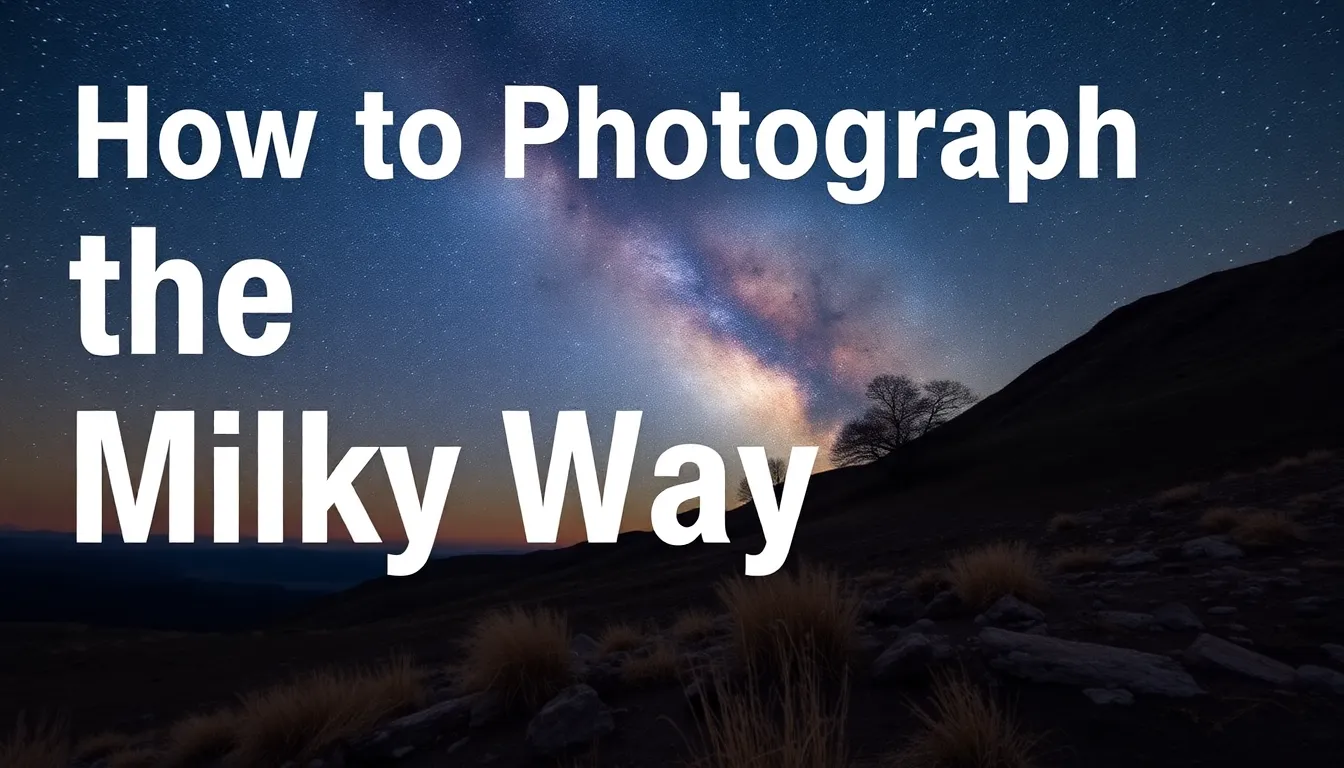
How to Photograph the Milky Way: A Complete Guide for Landscape Photographers
There’s a moment that arrives around midnight when you’re standing alone in the darkness, your eyes finally adjusted to the starlight above, when the Milky Way reveals itself in all its glory. The first time I witnessed this—really witnessed it—was in the high desert of Utah, where the light pollution felt like a distant memory and the galaxy stretched across the entire sky like spilled milk. That’s when I understood why learning how to photograph the Milky Way became an obsession for me.
The Milky Way is visible year-round, but it’s the act of capturing it—translating that ephemeral beauty into an image—that presents the real challenge. After years of late-night expeditions, countless failed attempts, and gradually refined techniques, I’ve learned what actually works in the field. This guide draws from those hard-won lessons.
Understanding When and Where to Shoot the Milky Way
The first thing to understand about how to photograph the Milky Way is that timing and location are everything. The galaxy is always there, but seasonal positioning and light pollution create a dramatic difference in what you can capture.
The core of the Milky Way—the dense, luminous center—is most visible from March through October in the Northern Hemisphere, with peak visibility occurring during May, June, and July. During winter months, the galactic center dips below the horizon or becomes severely obscured. In the Southern Hemisphere, the timeline is reversed, with the best visibility occurring from November through February.
Location matters equally. You need to escape light pollution. I recommend using tools like Light Pollution Maps or Dark Site Finder to locate areas at least 20-30 miles from major cities. When I plan these shoots, I’m not just looking for darkness—I’m scouting for interesting foreground elements that will anchor my composition and tell a story.
Essential Camera Settings for Milky Way Photography
When you’re out there, shivering in the pre-dawn cold, you need to know exactly what settings will capture the stars before they fade. These are the parameters I’ve refined through countless nights:
Aperture: Shoot at the widest aperture your lens allows. I typically use f/1.4 or faster. A wide aperture floods your sensor with starlight, which is the difference between a crisp image and a blurry one. This is why investing in a fast lens matters immensely—I’ve found the Sigma 35mm f/1.4 DG DN Art to be exceptional for this work, offering that crucial light-gathering ability without the premium price tag of professional glass.
Shutter Speed: The rule of thumb is the “500 Rule.” Divide 500 by your focal length to determine maximum shutter speed before stars become trails. For a 35mm lens, that’s roughly 14 seconds. On some newer, higher-resolution cameras, I use the more conservative “300 Rule” to avoid any star trailing whatsoever.
ISO: Push this high—I typically start at ISO 3200 and go up to 6400 or even 12,800 depending on ambient light and camera capability. Modern cameras handle high ISO remarkably well, and the noise is negligible compared to underexposed stars.
Focus: This is where many people struggle. Switch to manual focus, point your lens at a bright star, and focus until it appears as a sharp point of light. Use live view magnification to get it precisely right. It takes patience, but it’s the difference between sharp stars and fuzzy ones.
Composition: More Than Just Stars
When I’m learning how to photograph the Milky Way with students, I emphasize that the stars alone don’t make the image. The foreground is where your story lives.
Scout your location during daylight. Identify interesting elements—a distinctive rock formation, a weathered tree, an old barn—that will frame the galactic center. Position yourself so the Milky Way rises behind these elements, creating layers of interest. I always compose with the rule of thirds in mind, placing the galactic core a third of the way across the frame rather than dead center.
The landscape beneath the stars matters as much as the cosmos above. A purely black foreground loses the viewer’s sense of place. If your foreground is too dark, use a subtle light source—a distant headlamp, moonlight, or even a slow, careful pass with your flashlight—to add definition without overwhelming the night.
Gear That Makes the Difference
Having reliable equipment isn’t just about capturing better images; it’s about maintaining stability and focus when you’re working in challenging conditions.
A sturdy tripod is non-negotiable. Your tripod becomes your anchor in darkness. I use the Manfrotto Befree Advanced Tripod for Milky Way work—it’s light enough to hike to remote locations, yet stable enough to hold a full-frame camera steady during 15-second exposures. The last thing you need when you’ve driven two hours to a dark site is a wobbly tripod introducing blur.
Beyond the tripod and lens, I carry an intervalometer for time-lapses, a red headlamp to preserve night vision, and spare batteries. Cold drains batteries quickly, so I always bring more than I think I’ll need.
Processing Your Milky Way Images
The raw file from your camera is just the beginning. How to photograph the Milky Way effectively includes knowing how to develop those images afterward.
Increase overall exposure carefully—your histogram should just touch the right edge without clipping. Boost clarity and vibrance to enhance the galactic core’s definition. Add a subtle curve adjustment to the blacks to bring out subtle nebulosity. Be careful not to over-process; restraint often yields the most compelling results.
The Experience Matters
Here’s something I don’t see in many technical guides: the real value of learning how to photograph the Milky Way isn’t just the final image. It’s the experience itself. It’s standing under a galaxy so vast that it renders your daily concerns insignificant. It’s the patience required, the discipline of waiting for perfect conditions, the meditation of composing in darkness.
Every failed attempt teaches you something. Every clear night reveals new possibilities. That’s what keeps me returning to those dark skies, tripod in hand, searching for new ways to show the world what we’ve forgotten to look up and see.
Comments
Leave a Comment