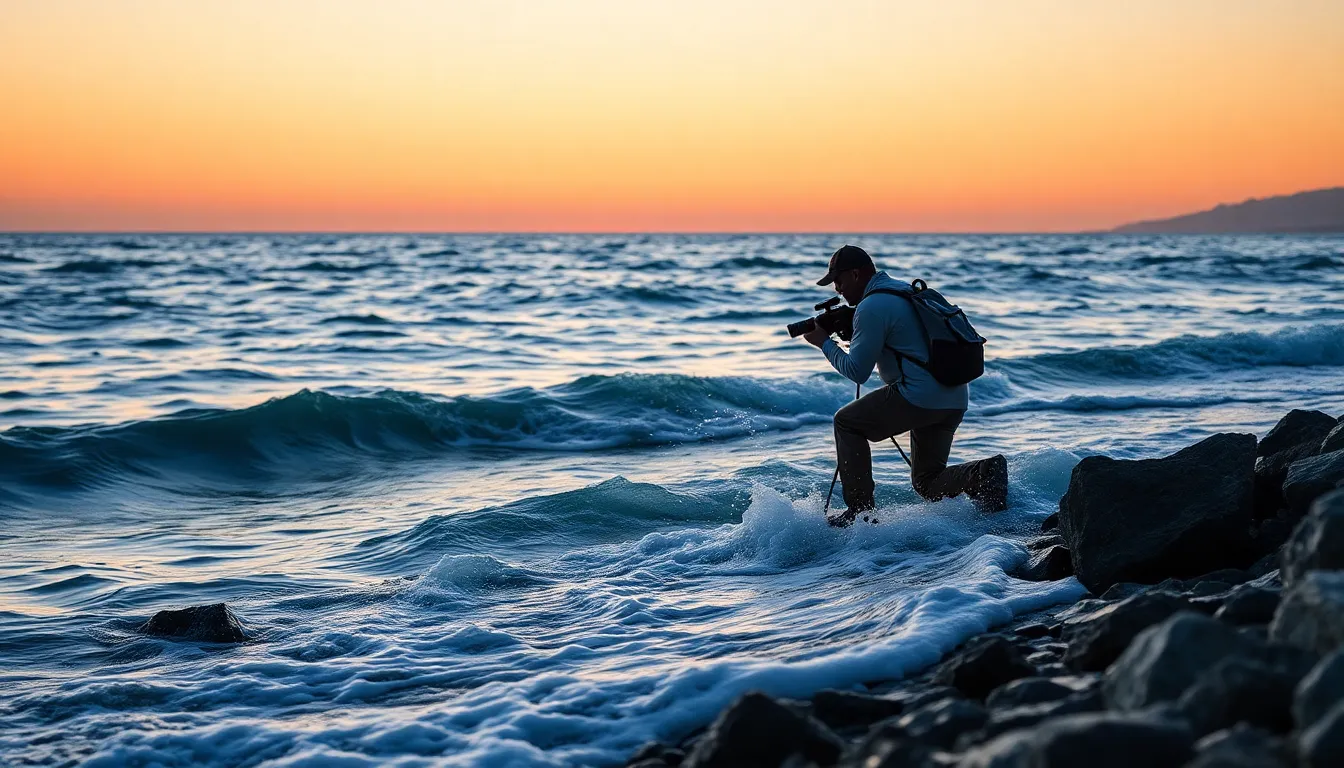
Capturing the Coast: Reading Light and Timing at the Water’s Edge
There’s something about standing at the edge of land and sea that shifts how I see light. The coast demands respect—wind, salt spray, unpredictable conditions—but it also offers some of the most dynamic lighting I’ve encountered in landscape photography. After years of chasing golden hour along rocky shores and sandy beaches, I’ve learned that successful coastal photography hinges on understanding how water reflects and bends light in ways inland scenes simply don’t.
The Challenge of Reflective Surfaces
Water is a mirror with a temperament. On calm mornings, it becomes a perfect reflector, doubling your compositional possibilities and extending the golden hour’s warmth across the frame. But this same reflectivity creates exposure metering headaches. Your camera’s meter will see that bright water and underexpose everything else, crushing the detail in the sky and land.
I always meter for the sky first—specifically for the area where clouds hold detail—then use exposure compensation or manual mode to preserve that information. Typically, I’ll overexpose by 0.5 to 1.5 stops from what the meter suggests, then fine-tune in post-processing. A graduated neutral density filter is invaluable here; I rarely shoot coastal scenes without one. The ND grad holds back the sky’s brightness while letting the foreground receive proper exposure, eliminating the need for aggressive compensation.
Timing: Beyond the Golden Hour
Yes, I chase sunrise and sunset like everyone else. That oblique light across wet sand creates texture that screams for photography. But I’ve stopped treating golden hour as the only viable window. Late morning—that harsh, overhead light most photographers avoid—can yield stunning results at the coast.
When the sun is high and the wind picks up, water becomes animated. Waves catch light differently; you get sparkle and drama instead of soft reflection. At f/11 to f/16 with a polarizing filter to control glare, I find these conditions render incredible detail in whitecaps and turbulent water. Shoot between 10 AM and 2 PM when others are sleeping in, and you’ll have empty beaches with complex, interesting light.
The polarizing filter deserves emphasis here. Rotating it while looking through the viewfinder reveals or conceals reflections in the water and sky—a real-time tool for controlling how much of the coast’s inherent brightness reaches your sensor.
Composition and the Horizon
The most common coastal mistake I see is centering the horizon. Water demands stronger composition. Place it in the lower third if the sky is dramatic, or in the upper third if the water’s texture and color are your story.
Look for leading lines—a jetty, the edge of a tide pool, the curve of a cove—to draw the eye into the frame. These lines become exponentially more effective at the coast because they contrast sharply with the sea. I’ll often spend twenty minutes walking a beach purely to discover how the land’s geometry interacts with the water at different angles.
Protecting Your Gear
The coast is beautiful and hostile to cameras. Salt spray carries particles that corrode metal and degrade seals. I’ve lost sensors to negligence; I won’t repeat that mistake.
I use a weather-sealed body without exception. After each session, I wipe lenses with a clean microfiber cloth and leave my gear in a sealed bag with silica gel overnight. Before changing lenses, I turn my back to the wind—a simple gesture that prevents salt-laden air from reaching the sensor. These habits have extended the life of my equipment considerably.
The Reward
Standing at the coast as light changes—watching the water shift from pewter to gold to deep blue—reminds me why I do this. The technical details matter, but they exist to serve the experience of being present in a landscape. Respect the coast’s conditions, understand its light, and it will reward you with images that carry genuine weight and atmosphere.
Comments
Leave a Comment