There’s a particular kind of panic that sets in when you arrive at a location and the sky is already turning. You’ve hiked in, the light is moving fast, and your brain starts skipping steps. Forget composition. Just shoot. Get something before it’s gone. I’ve done it more times than I’d like to admit, and almost every time I come home with technically fine frames that feel hollow because I grabbed the light without earning the image.
That tension between urgency and deliberateness is exactly what Nigel Danson works through in a recent tutorial where he commits to getting up before dawn and shooting, no plan, no scouted location, just a place he’d walked before but never seriously photographed. Watch the full tutorial on YouTube before or after reading this breakdown. What he demonstrates in real time is the actual hard part of landscape photography: not the gear, not the editing, but the decision-making under pressure in the field.
Twenty years into doing this for a living, I still catch myself defaulting to reaction instead of intention when the clock is ticking. Watching someone else navigate that pressure methodically is a useful reset. Here’s how Nigel approaches it, step by step.
Step 1: Commit to the Shoot Regardless of Conditions
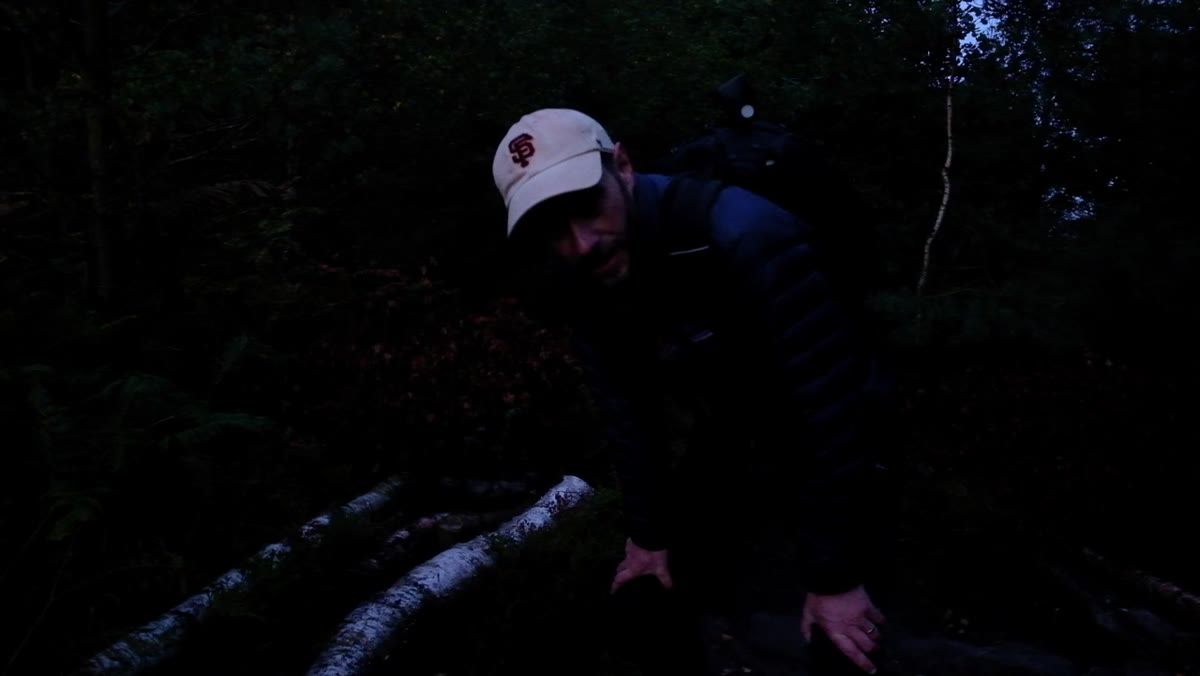
 Nigel arriving at location in pre-dawn darkness with gear
Most of the images I’m proudest of came from mornings I almost didn’t go. Weather apps are estimates. Clouds that look like a ceiling on your phone can break into something extraordinary by the time you’re standing in front of them. Nigel’s rule here is simple: go anyway. He arrives before 5:30 a.m. to a location he knows on foot but hasn’t committed to photographically. The commitment to showing up is the first creative decision, and it’s the one most photographers skip.
Nigel arriving at location in pre-dawn darkness with gear
Most of the images I’m proudest of came from mornings I almost didn’t go. Weather apps are estimates. Clouds that look like a ceiling on your phone can break into something extraordinary by the time you’re standing in front of them. Nigel’s rule here is simple: go anyway. He arrives before 5:30 a.m. to a location he knows on foot but hasn’t committed to photographically. The commitment to showing up is the first creative decision, and it’s the one most photographers skip.
If you wait for a guaranteed sunrise, you’ll wait a long time. Build the habit of arriving without expectations, and you’ll start seeing possibilities instead of disappointments.
Step 2: Walk Before You Shoot
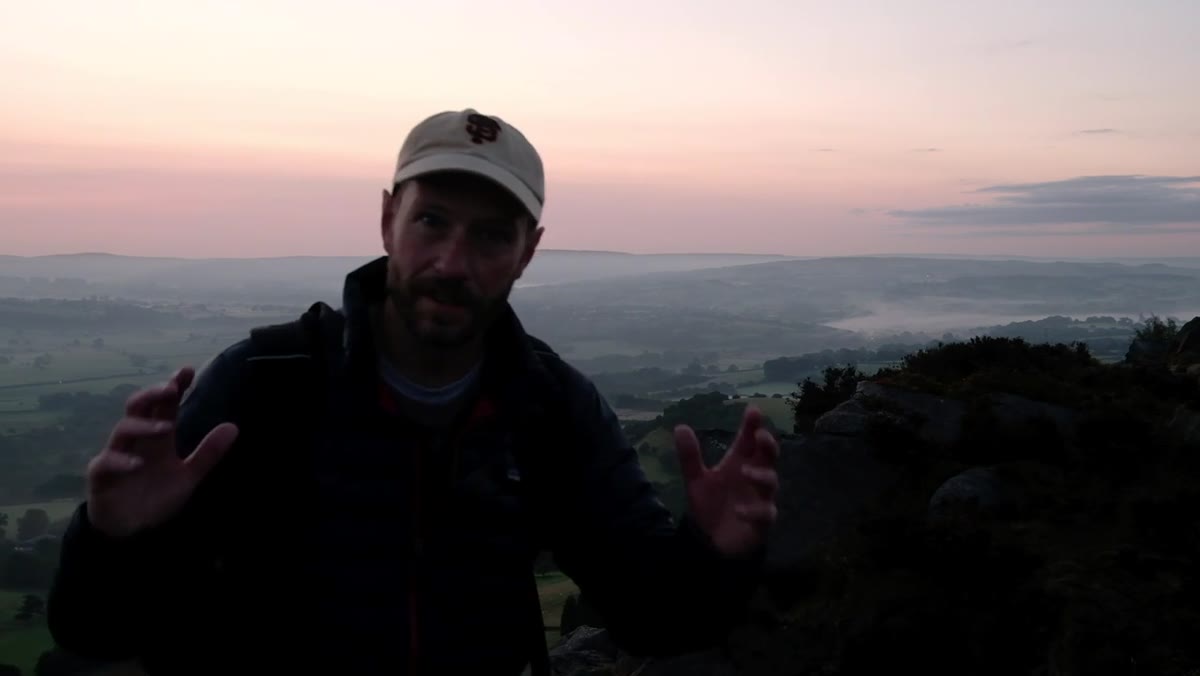
 Nigel moving toward the hilltop, camera still in bag
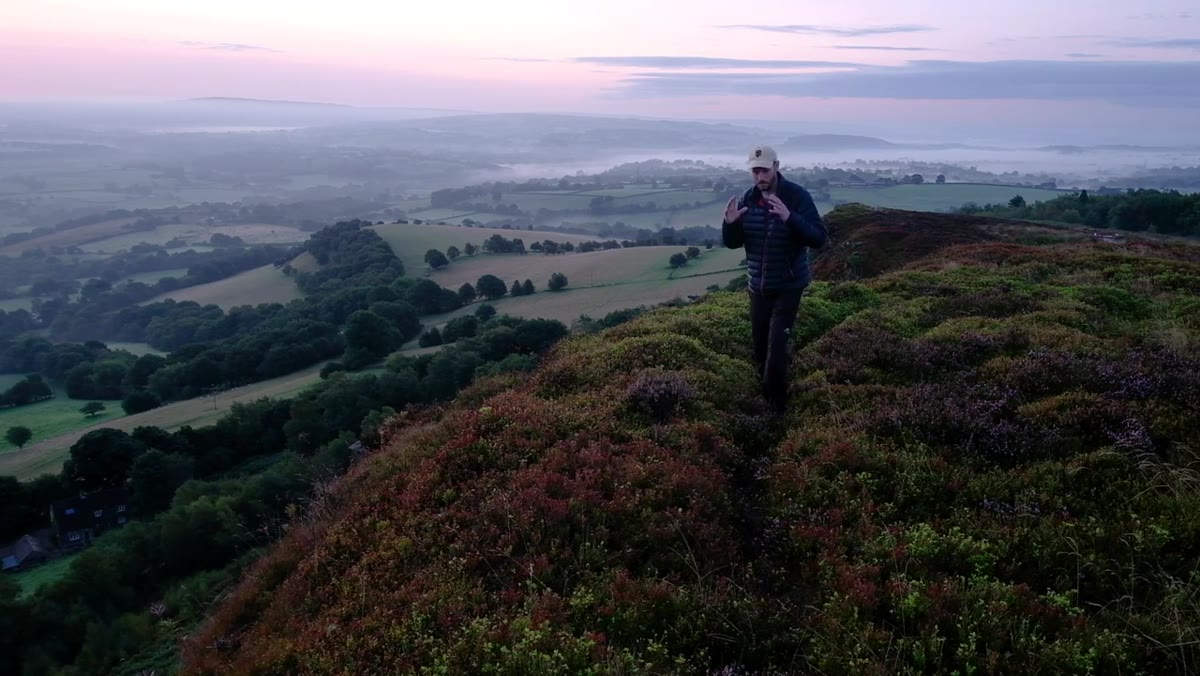
The instinct when light is happening is to pull out the camera immediately. Nigel resists this. He moves toward the high ground first, reads what’s actually in front of him, fog in the valley, heather on the slopes, a sky with real potential, and only then starts thinking about where to plant his feet. This reconnaissance, even when it’s only a few minutes, changes everything.
Nigel moving toward the hilltop, camera still in bag
The instinct when light is happening is to pull out the camera immediately. Nigel resists this. He moves toward the high ground first, reads what’s actually in front of him, fog in the valley, heather on the slopes, a sky with real potential, and only then starts thinking about where to plant his feet. This reconnaissance, even when it’s only a few minutes, changes everything.
When I arrive at a new location I’ve never shot, I give myself at least five minutes of just looking. No camera, no phone. Let your eyes do the work. The scene will tell you something if you’re quiet enough to hear it.
Step 3: Find Composition Before the Light Peaks
 Nigel searching for foreground elements with sunrise imminent
This is the step most photographers sacrifice first under time pressure, and Nigel is explicit about not sacrificing it. Even with sunrise minutes away, he’s still moving laterally, testing angles, looking for a foreground element that does real work. He settles on a path that cuts a diagonal from the lower left corner of the frame, leading the eye through heather and ground cover toward the misty hills beyond.
Nigel searching for foreground elements with sunrise imminent
This is the step most photographers sacrifice first under time pressure, and Nigel is explicit about not sacrificing it. Even with sunrise minutes away, he’s still moving laterally, testing angles, looking for a foreground element that does real work. He settles on a path that cuts a diagonal from the lower left corner of the frame, leading the eye through heather and ground cover toward the misty hills beyond.
The goal he articulates is simplicity in the foreground, because the middle distance and background are already complex with fog and rolling terrain. When your background is busy, your foreground has to be clean and clear, or the image collapses into noise. Pick one strong leading element and let everything else support it.
Step 4: Know When to Break Your Own Rules
 Nigel switching to a longer lens toward the rising sun
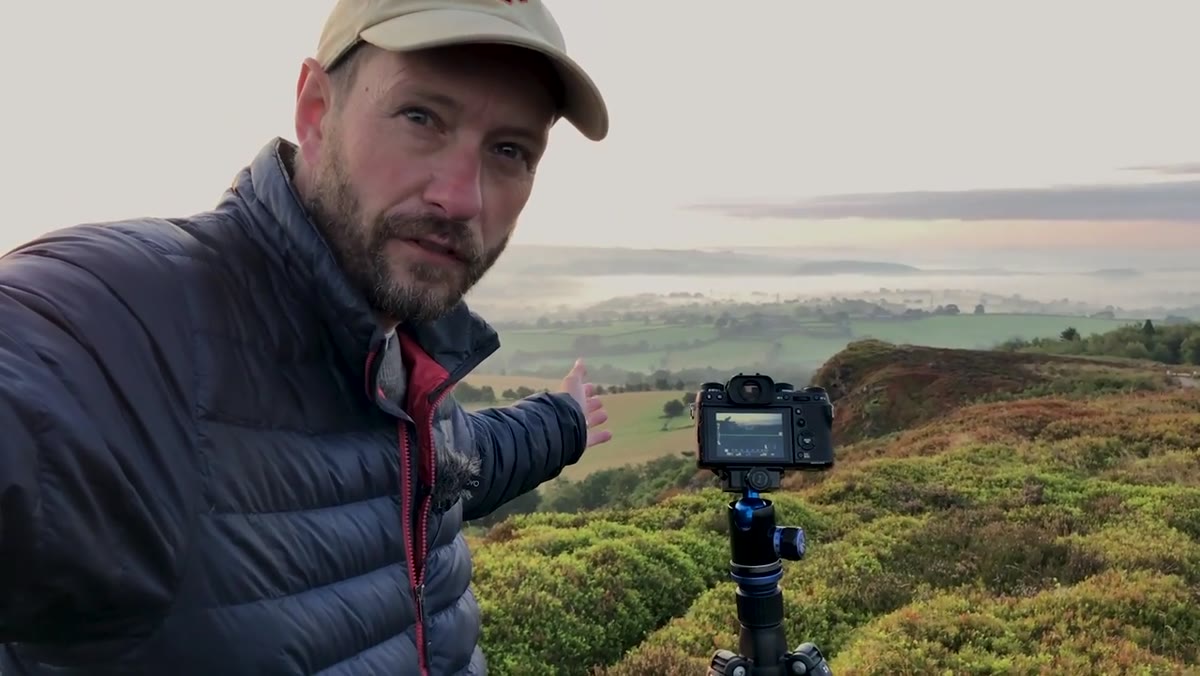
Nigel mentions he doesn’t typically swap lenses mid-shoot. He prefers to commit to a single composition and work it. But when the sun rises as a vivid red ball through the haze, he makes an exception. He grabs a longer lens, captures a few frames of the compressed, atmospheric sun, then switches back to his main composition. The point isn’t to chase everything. It’s to recognize when something genuinely extraordinary justifies a deviation from your process.
Nigel switching to a longer lens toward the rising sun
Nigel mentions he doesn’t typically swap lenses mid-shoot. He prefers to commit to a single composition and work it. But when the sun rises as a vivid red ball through the haze, he makes an exception. He grabs a longer lens, captures a few frames of the compressed, atmospheric sun, then switches back to his main composition. The point isn’t to chase everything. It’s to recognize when something genuinely extraordinary justifies a deviation from your process.
I have a version of this rule in my own practice. My default is to stay locked on one composition until I’ve fully exhausted it. But there are moments, a shaft of light, a sudden break in the fog, a bird landing exactly where it should, where the correct answer is to adapt. The key is that you adapt consciously, not out of panic.
Step 5: Use Exposure Bracketing Instead of Filters When Light is Complex
 Nigel explaining five-bracket sequence at two-thirds stop intervals
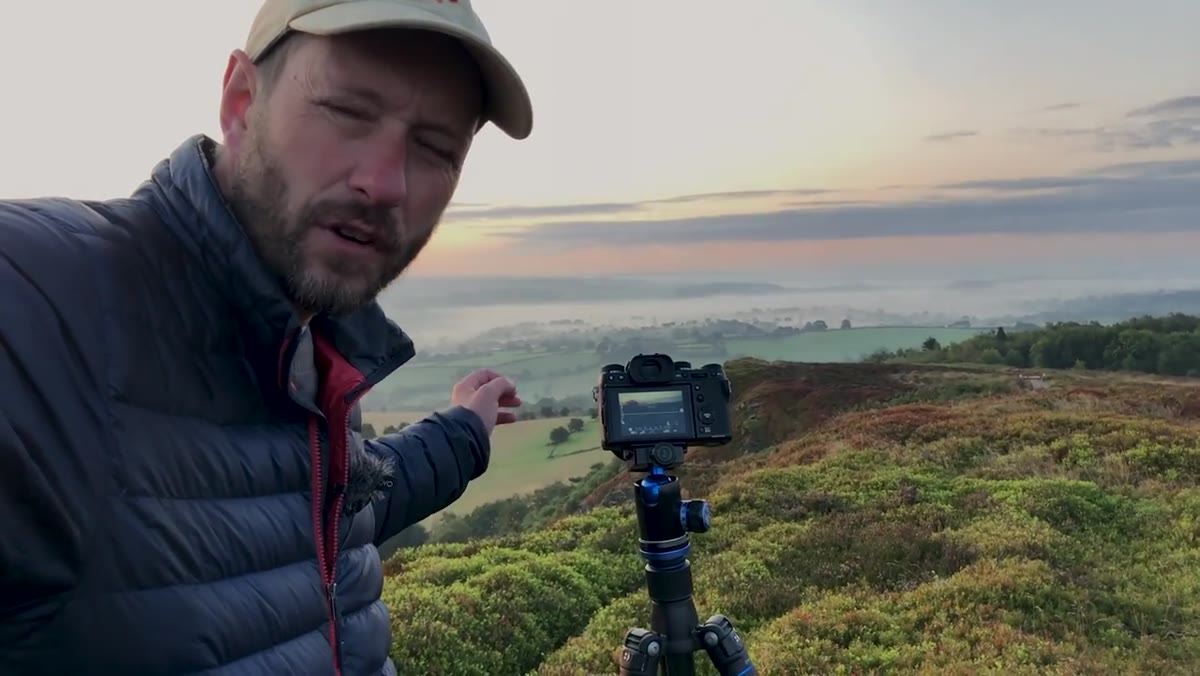
Rather than reaching for a graduated ND filter to balance the bright sky against the darker foreground, Nigel shoots a five-frame bracket at two-thirds of a stop per step. Two frames expose for the brighter end of the range, two expose for the shadow detail, and one sits at metered exposure. This gives him enough raw material to blend in post without the risk of a filter edge cutting awkwardly through a complicated horizon line of hills and mist.
Nigel explaining five-bracket sequence at two-thirds stop intervals
Rather than reaching for a graduated ND filter to balance the bright sky against the darker foreground, Nigel shoots a five-frame bracket at two-thirds of a stop per step. Two frames expose for the brighter end of the range, two expose for the shadow detail, and one sits at metered exposure. This gives him enough raw material to blend in post without the risk of a filter edge cutting awkwardly through a complicated horizon line of hills and mist.
In practice, this approach works best when your horizon isn’t a clean, flat line. Filters are fast and effective on seascapes with a sharp horizon, but on moorland or mountain terrain where the skyline is irregular, bracketing gives you clean edges to work with later. Shoot on a tripod, keep your composition locked between frames, and the blend in Lightroom or Photoshop is straightforward.
Step 6: Keep the Foreground Simple When Everything Else Is Not
 Wide composition showing path, heather foreground, foggy hills beyond
Once Nigel settles into his main composition, he keeps returning to simplification. The mist, the rolling hills, the warming light are all creating visual complexity in the background. His job becomes protecting the foreground from adding to that complexity. He positions himself so the path creates a clean diagonal, and the ground cover catches the early sidelight without fragmenting into distracting texture.
Wide composition showing path, heather foreground, foggy hills beyond
Once Nigel settles into his main composition, he keeps returning to simplification. The mist, the rolling hills, the warming light are all creating visual complexity in the background. His job becomes protecting the foreground from adding to that complexity. He positions himself so the path creates a clean diagonal, and the ground cover catches the early sidelight without fragmenting into distracting texture.
This is a principle I come back to constantly in workshops: a photograph can sustain one area of complexity. If the sky is dramatic, simplify the foreground. If the foreground is intricate, let the sky breathe. When both are competing at full volume, neither wins.
What I’d Add From My Own Experience
The scenario Nigel puts himself through, arriving slightly late, working a location he hasn’t fully scouted, shooting in conditions he didn’t fully anticipate, is actually the best training scenario I know. It’s easy to make good images when you’ve pre-visualized everything in perfect conditions. The real education happens when the situation doesn’t cooperate.
A mentor told me once that the mountain doesn’t care about your schedule. He meant it as patience advice, but I’ve come to think of it as a compositional principle too. The landscape isn’t going to arrange itself around your plan. You have to arrive open enough to see what’s actually there, and disciplined enough to respond to it with intention rather than reflex. That balance, openness plus discipline, is what separates the images that move people from the ones that just document a nice morning.
The single thing to carry out of this tutorial is Nigel’s insistence on finding the composition even when time is short. Light without composition is just documentation. If you do nothing else differently after watching this, give yourself sixty more seconds to find your foreground before you fire the first frame. That one habit will change your keeper rate more than any piece of gear you’ll ever buy.
Watch the full tutorial on YouTube to follow along with Nigel’s decision-making in real time as the light changes around him.
Comments
Leave a Comment