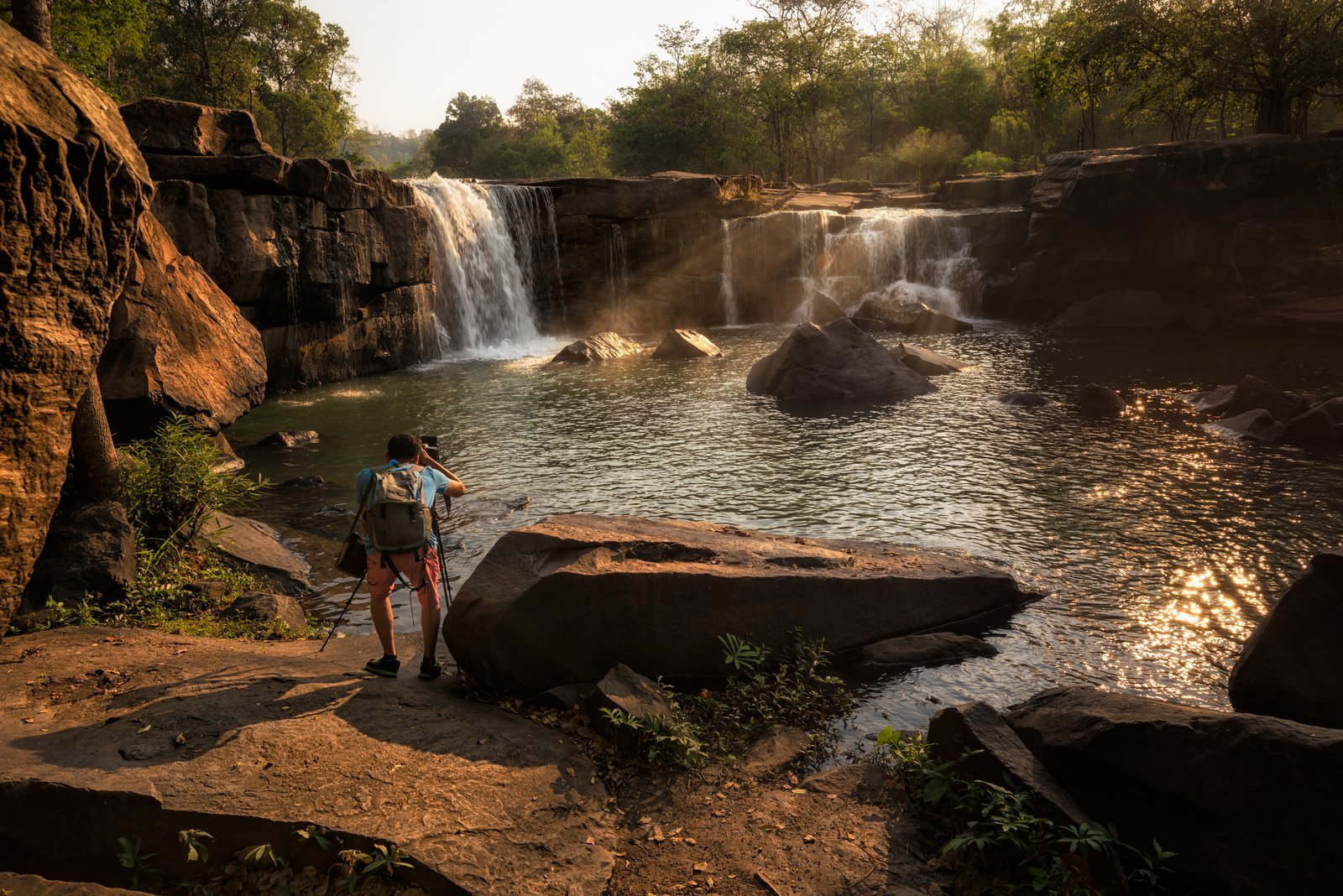
There’s a particular kind of disappointment that hits when you drive two hours into the Cascades, hike forty minutes to a waterfall, set up your tripod in the middle of a freezing creek, and come home with photographs that look exactly like every other waterfall photograph on the internet. Silky white water. Green moss. A little bit of mist. Technically fine. Completely forgettable.
I’ve made thousands of those photographs. After twenty years shooting landscapes full-time, I can tell you that the problem almost never starts with the camera settings. It starts much earlier than that.
The Real Reason Waterfalls Are Hard to Photograph Well
Most photographers treat a waterfall like a subject. It isn’t, or at least it isn’t only. A waterfall is light, and water, and the land around it, and the time of day, and the season, and the mood of the sky. When you isolate it from those relationships and just point your lens at moving water, what you get is a document, not a photograph.
The deeper technical problem is dynamic range. A waterfall in direct sunlight can span 12 to 15 stops of light from the bright core of the falling water to the shadows tucked under the surrounding rocks and ferns. Your camera sensor, even a modern full-frame like a Sony A7R V or a Nikon Z8, handles around 14 to 15 stops under ideal conditions. That sounds like enough, but it isn’t, because the water itself is constantly moving and reflecting in ways that blow highlights in fractions of a second. The exposure you need to protect the water often underexposes the surrounding scene by two or three stops. You’re always making a tradeoff.
Understanding that tradeoff is the whole game.
How to Expose for Moving Water Without Destroying the Rest of Your Frame
I shoot everything in manual mode, always. I won’t get into the philosophy of that here, but the practical reason is that a waterfall environment fools evaluative metering badly. The bright water against dark rocks sends your camera chasing ghosts.
Start by spot-metering the brightest part of the falling water and setting your exposure so those highlights land at no more than plus-one stop on your histogram. For most mid-size waterfalls in open shade, that puts me around ISO 64, f/11, and somewhere between 1/4 second and 2 seconds depending on the light. I use a 6-stop ND filter, the B+W 106, which runs about $80 to $100 for a 77mm thread, and it’s been in my bag for eight years. Don’t let the exposure time determine your settings. Let your settings determine the exposure time and then use filtration to get there.
The silky-water look happens anywhere between 1/4 second and about 3 seconds. Below that, the water freezes and you lose the sense of motion. Above 3 or 4 seconds, the water begins to look like white fog, which loses texture and can actually look less dynamic, not more. For most waterfalls I find the sweet spot around 1 second. That’s not a rule, it’s a starting point.
Reading the Scene Before You Set Up the Tripod
I arrive before dawn, usually while it’s still dark, and I spend the first 20 to 30 minutes just walking. No camera, no tripod. I’m looking for the angle that makes the water a part of the landscape rather than the whole of it. Where’s the foreground? Is there a rock in the stream I can use to anchor the frame? What does the water sound like, and does the visual composition communicate that?
The best waterfall compositions almost always include something still. Moving water needs a counterweight. A mossy boulder, a cluster of ferns, a single dead tree on the bank. Without it, the eye has nowhere to rest, and the photograph exhausts you.
I also look at the sky. Overcast days are not a compromise. They’re often ideal, because diffused light collapses the dynamic range problem I described above and gives you color saturation in the greens and blacks that direct sun destroys with glare.
When the Conditions Refuse to Cooperate
A mentor of mine used to say that the mountain doesn’t care about your schedule. I’ve carried that with me for years, usually while standing in cold water waiting for clouds that may or may not show up.
A few winters ago I drove six hours to the Oregon coast to photograph a particular sea stack with a waterfall running down its face at high tide. Fog rolled in the night I arrived and stayed for two full days. I shot almost nothing. On the morning of the third day, as I was packing my truck to drive home, the fog broke for about forty minutes. The light that came through was unlike anything I had planned for. That photograph, the one I didn’t drive there to take, became the best-selling print I’ve ever made.
I’m not offering that as a story about luck. I’m offering it as a story about staying in the field. You can’t make the photograph if you’ve already driven home.
The One Thing That Changes Everything
If I had to reduce twenty years of waterfall photography to a single piece of advice, it would be this: stop trying to photograph the water and start trying to photograph the light on the water.
The best waterfall images aren’t about motion. They’re about a specific quality of light at a specific moment in a specific place. When you start chasing that instead of the waterfall itself, the whole approach changes, and so do the photographs.
Comments
Leave a Comment