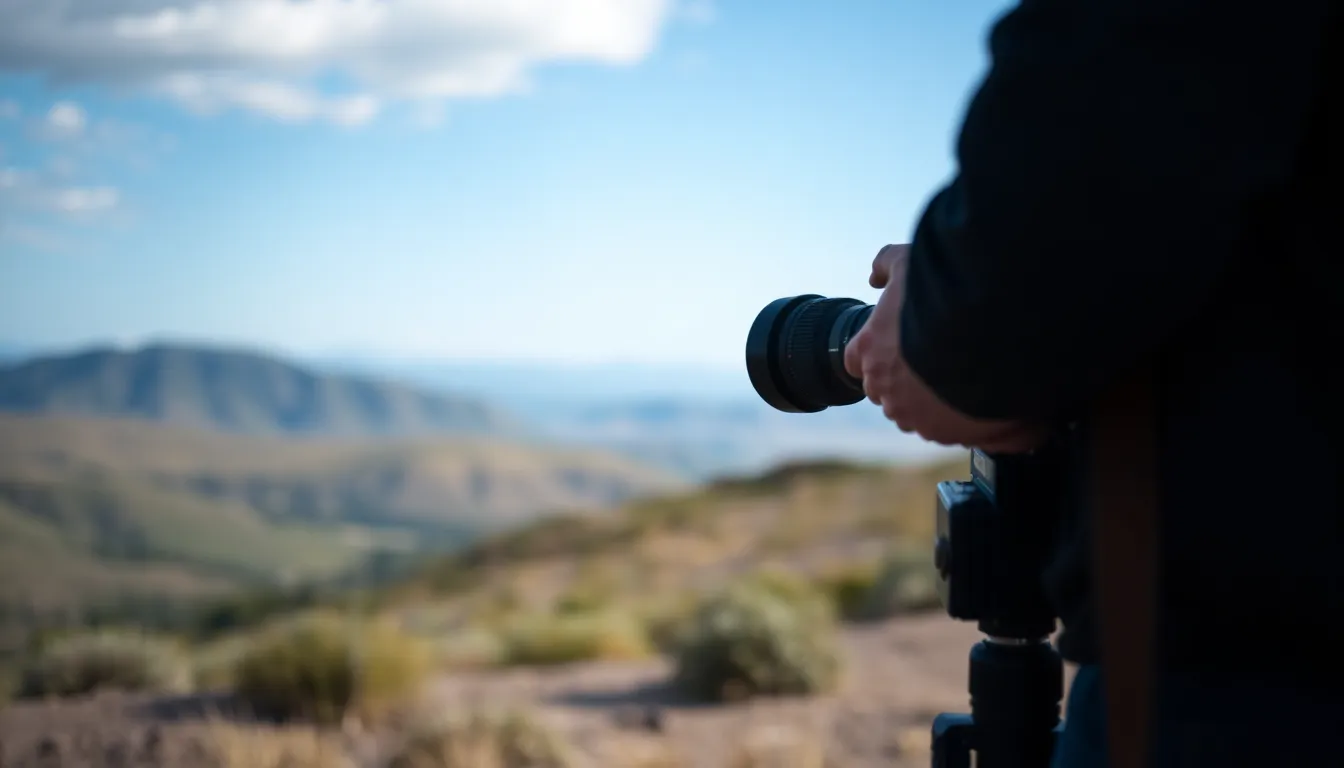
Finding Balance in the Frame: The Art of Landscape Composition
I’ve spent countless mornings standing in frost-covered fields, watching light transform an ordinary hillside into something extraordinary. But I’ve learned that even the most beautiful light can’t save a poorly composed image. The strongest landscape photographs balance technical skill with intentional visual structure—and that structure begins long before you press the shutter.
The Three-Layer Approach
When I arrive at a location, I resist the urge to immediately frame a shot. Instead, I walk the space and mentally divide what I see into foreground, middle ground, and background. This layering creates depth and prevents the flat, two-dimensional feel that weakens many landscape photos.
For your foreground, include something meaningful—weathered rocks, wildflowers, or textured grass. Position yourself low, sometimes kneeling or lying prone, to give these elements visual weight. Your middle ground acts as a transition, typically featuring the main subject—a tree line, mountain ridge, or water feature. The background should provide context without overwhelming: distant mountains, sky, or soft bokeh created by compression.
I use my 24-70mm lens at different focal lengths to test how compression affects these layers. At 24mm, elements feel separated and dramatic. At 70mm, they compress together more subtly. There’s no “correct” choice—only what serves your compositional intent.
Leading Lines That Actually Lead
Every landscape contains invisible pathways. A river might curve through a valley. A fence line might slash diagonally across the frame. A row of trees might recede toward the horizon. These aren’t just compositional tools—they’re invitations that guide your viewer’s eye exactly where you want it to go.
When I scout a location, I ask: What naturally draws the eye inward? A road disappearing into fog. A stream reflecting sky. Stone steps ascending a hillside. Position these lines intentionally—usually entering the frame from a lower corner and moving toward your main subject. Avoid lines that exit the frame abruptly or create visual confusion.
I often use my camera’s grid overlay (enable it in your settings) to position leading lines along the third vertical or horizontal lines, reinforcing compositional balance while keeping the movement active.
The Rule of Thirds, Thoughtfully Applied
I don’t treat the rule of thirds as law—I treat it as a conversation starter. The four intersection points where grid lines meet are where human eyes naturally settle. Placing your primary subject near one of these intersections creates immediate visual interest without feeling accidental.
However, I’ve discovered that centering a subject works beautifully when you have perfect bilateral symmetry—a reflection in still water, mountains mirrored across a valley. The key is intentionality. Centered composition should feel deliberate, not like you didn’t know where to position your subject.
Negative Space as Active Composition
Perhaps the most underused compositional element is what isn’t there. A vast expanse of sky, a quiet stretch of beach, or an open meadow provides visual rest. This negative space prevents your image from feeling cluttered and gives the viewer permission to breathe.
I often compose with 60% sky and 40% land (or vice versa) when the sky contains weather or color. When the sky is featureless, I reverse this ratio, keeping it minimal. Never divide your frame exactly in half—the asymmetry creates tension that holds attention.
Making It Instinctive
The strongest compositions feel inevitable, like there was only ever one way to frame the scene. This inevitability comes from practice. Before your next shoot, spend 10 minutes simply observing. Identify your foreground element. Trace the leading lines. Note where light falls. Then raise your camera—not to shoot, but to confirm what you’ve already decided.
This deliberate pause transforms composition from accident into intention. And intention is what separates a pleasant photograph from one that stays with you.
Comments (3)
Solid advice. Especially the part about taking your time with it.
Couldn't agree more. I've seen this make a huge difference in workflows work specifically.
Printing this out and pinning it next to my monitor. That good.
Leave a Comment