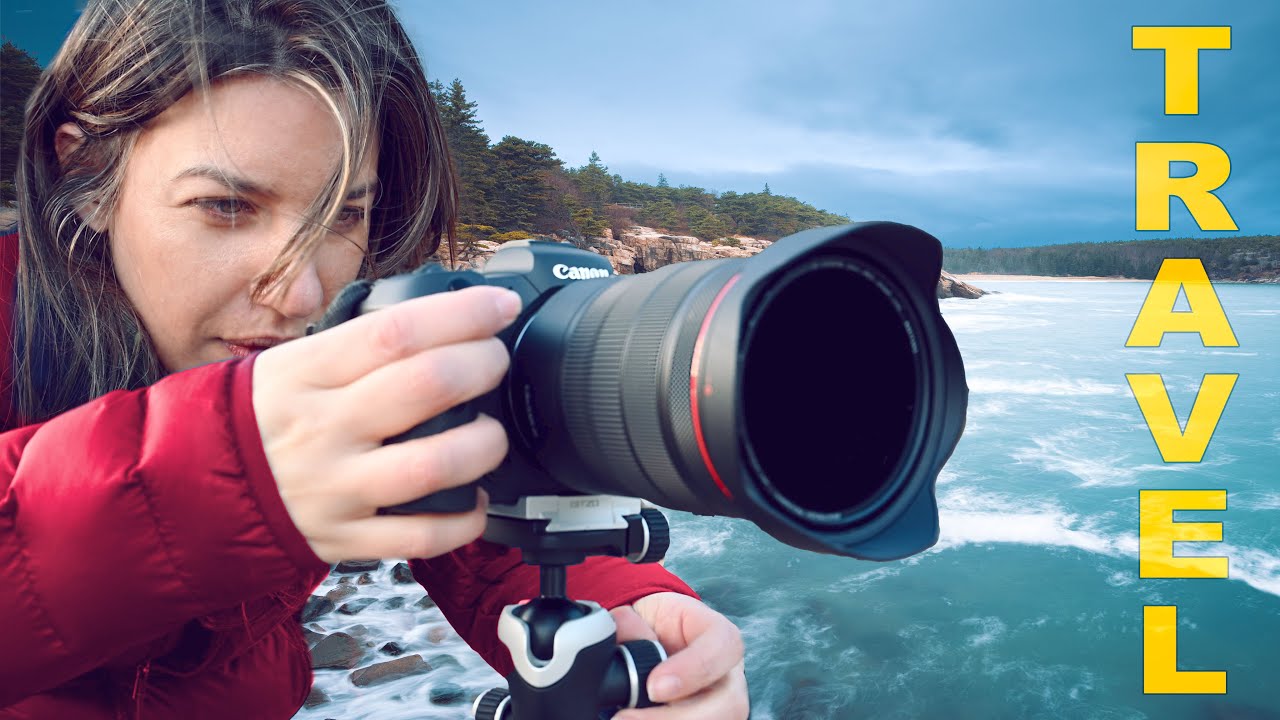
Every few years, the question forces itself back into my life: is the system I’m carrying still the right one? I’ve been shooting landscapes for two decades out of Bend, Oregon, and I can tell you that choosing a camera body isn’t about specs on a page. It’s about what you’re willing to strap to your back at 4am when the temperature is in the thirties and the trailhead is still two miles out. The wrong choice costs you in ways that don’t show up in megapixel counts.
That’s why I paid close attention when Tony and Chelsea Northrup published their field comparison of the Nikon Z9, Sony Alpha 1, and Canon R5 - filmed on location in Acadia National Park, which is exactly the kind of demanding mixed-use terrain that exposes a system’s real character. Watch the full tutorial on YouTube before or after reading this. My notes below are written for landscape and travel photographers specifically, pulling out what I think matters most for our kind of work.
The core problem the video addresses is one I hear constantly in my workshops: photographers shopping at the top of the market, trying to figure out whether to commit to a new system or upgrade within their current one. All three of these cameras are extraordinary. The question is which extraordinary suits your body, your bag, and your style of moving through the world.
Step 1: Lay Out the Full System, Not Just the Body
 Caption: Three camera systems laid out with matching lens sets
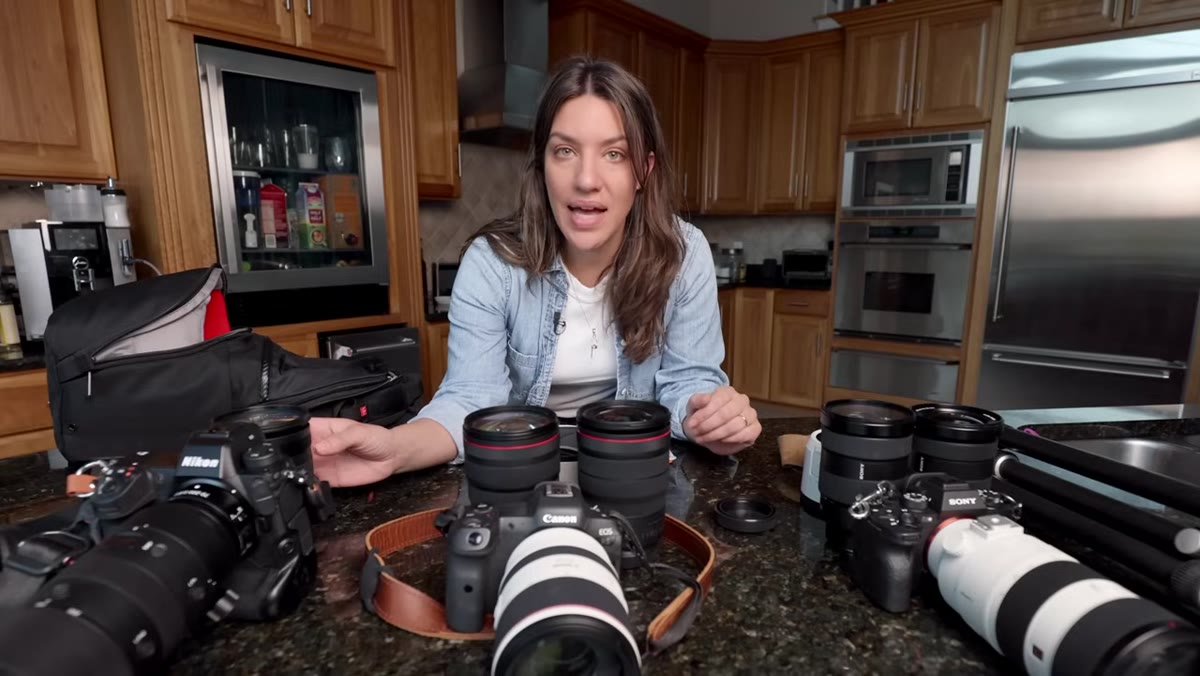
Before Chelsea weighs a single camera, she makes a point that I think most buyers miss entirely. She lines up each body alongside the actual lenses she plans to travel with - a 70-200mm f/2.8, a wide-angle zoom, and a standard 24-70mm f/2.8 for each system. This is the correct way to evaluate weight and packability. The body alone tells you almost nothing useful. Your lens kit is where the real mass lives.
Caption: Three camera systems laid out with matching lens sets
Before Chelsea weighs a single camera, she makes a point that I think most buyers miss entirely. She lines up each body alongside the actual lenses she plans to travel with - a 70-200mm f/2.8, a wide-angle zoom, and a standard 24-70mm f/2.8 for each system. This is the correct way to evaluate weight and packability. The body alone tells you almost nothing useful. Your lens kit is where the real mass lives.
Start your own evaluation the same way. List the three or four lenses you carry on a typical shoot, then look up the weight for each system’s equivalent glass. Don’t compare a body-only weight to a full kit. That’s comparing a campsite to a mountain.
Step 2: Weigh the Full Kit and Be Honest About What Your Body Tells You
 Caption: Scale showing total Nikon Z9 system weight in ounces
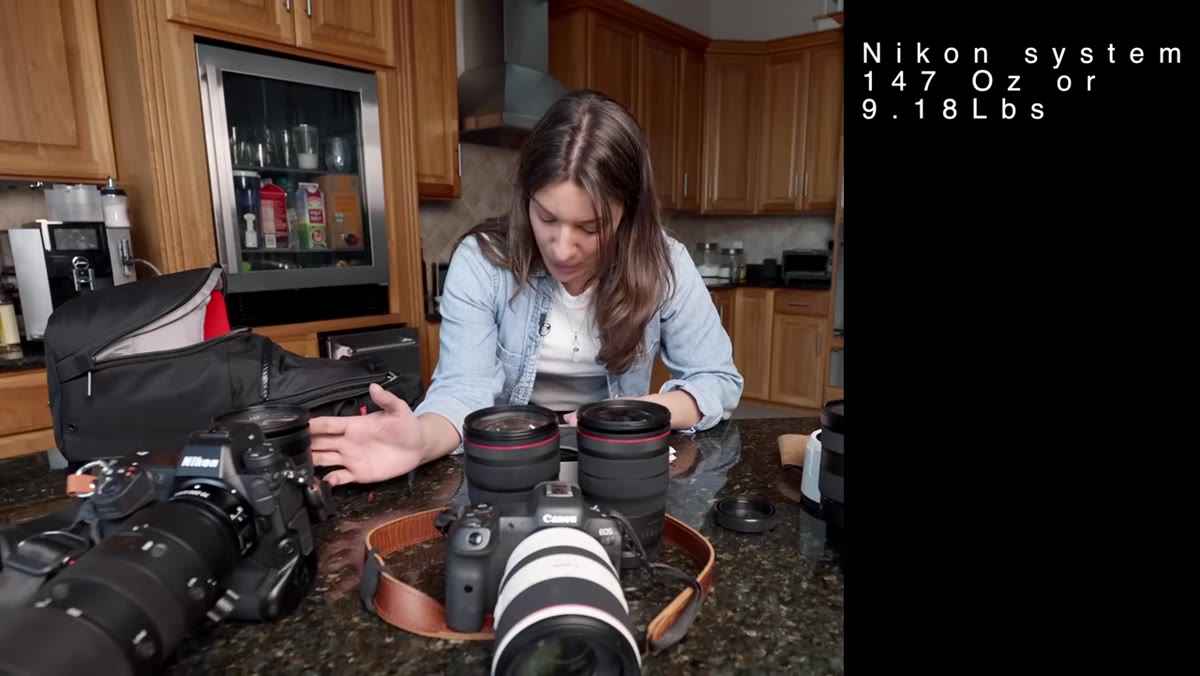
The numbers Chelsea records are telling. The Nikon Z9 system with comparable glass comes in at roughly 9.2 pounds. The Canon R5 system lands around 7.75 pounds. The Sony Alpha 1 system is the lightest of the three at about 7.3 pounds. That two-pound difference between the Nikon and Sony might sound like marketing noise, but carry either system for five hours on a coastal trail and your shoulder will have a strong opinion.
Caption: Scale showing total Nikon Z9 system weight in ounces
The numbers Chelsea records are telling. The Nikon Z9 system with comparable glass comes in at roughly 9.2 pounds. The Canon R5 system lands around 7.75 pounds. The Sony Alpha 1 system is the lightest of the three at about 7.3 pounds. That two-pound difference between the Nikon and Sony might sound like marketing noise, but carry either system for five hours on a coastal trail and your shoulder will have a strong opinion.
I learned this lesson in my early thirties when I was stubborn about hauling a heavier system because the image quality felt safer. My mentor once told me that the best camera is the one you actually bring to the edge. He was right. A slightly lighter kit that comes with you to every location will always outperform a heavier one that stays in the car.
Step 3: Understand Why the Z9’s Size Exists
 Caption: Nikon Z9 with built-in vertical grip visible
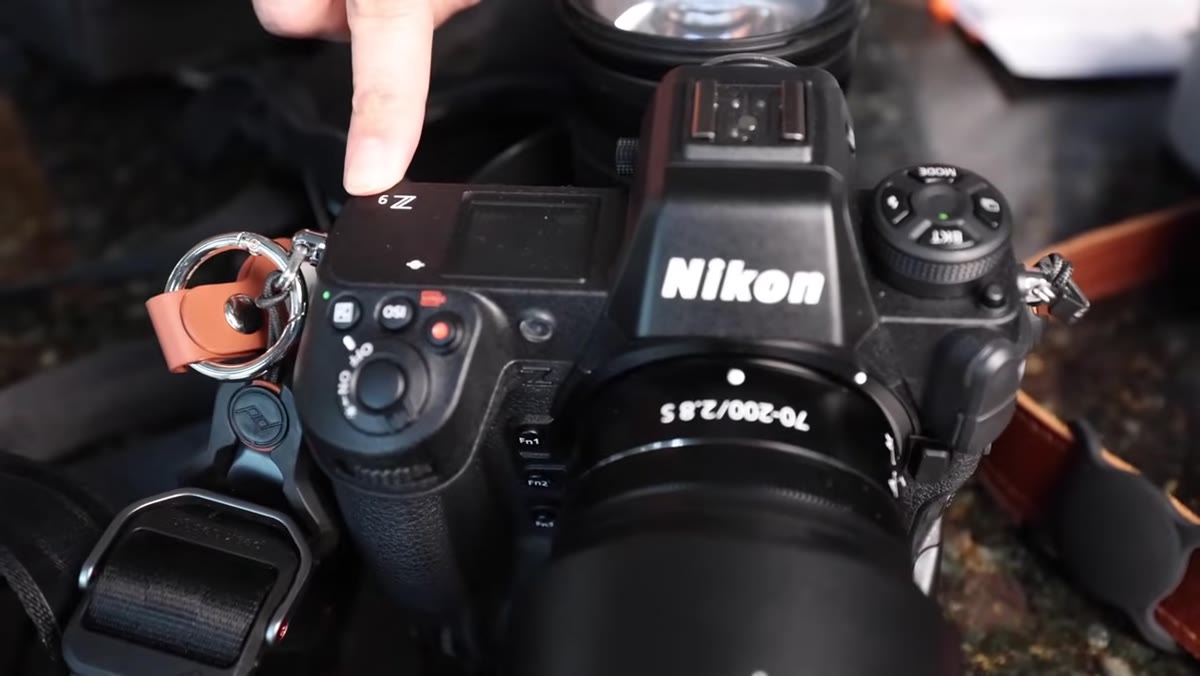
The Nikon Z9 is visibly larger than its competitors because of its integrated vertical grip - there is no separate battery grip to buy or lose. For sports and wildlife photographers, that design makes perfect sense. For landscape work, it’s worth pausing. Chelsea notes the Z9 is the heaviest-looking system, and it earns that reputation. But that bulk is not wasted. It houses a larger battery, better thermal management for high-speed shooting, and a more substantial handling surface that some photographers with larger hands genuinely prefer.
Caption: Nikon Z9 with built-in vertical grip visible
The Nikon Z9 is visibly larger than its competitors because of its integrated vertical grip - there is no separate battery grip to buy or lose. For sports and wildlife photographers, that design makes perfect sense. For landscape work, it’s worth pausing. Chelsea notes the Z9 is the heaviest-looking system, and it earns that reputation. But that bulk is not wasted. It houses a larger battery, better thermal management for high-speed shooting, and a more substantial handling surface that some photographers with larger hands genuinely prefer.
If you shoot landscapes and wildlife on the same trip - something I do regularly in the Pacific Northwest - the Z9’s versatility argument gets stronger. But if your trips are purely about light, composition, and patience, you may be paying a weight tax for features you’ll never use.
Step 4: Evaluate the Menu System as a Field Tool
 Caption: Sony Alpha 1 menu system shown on camera screen
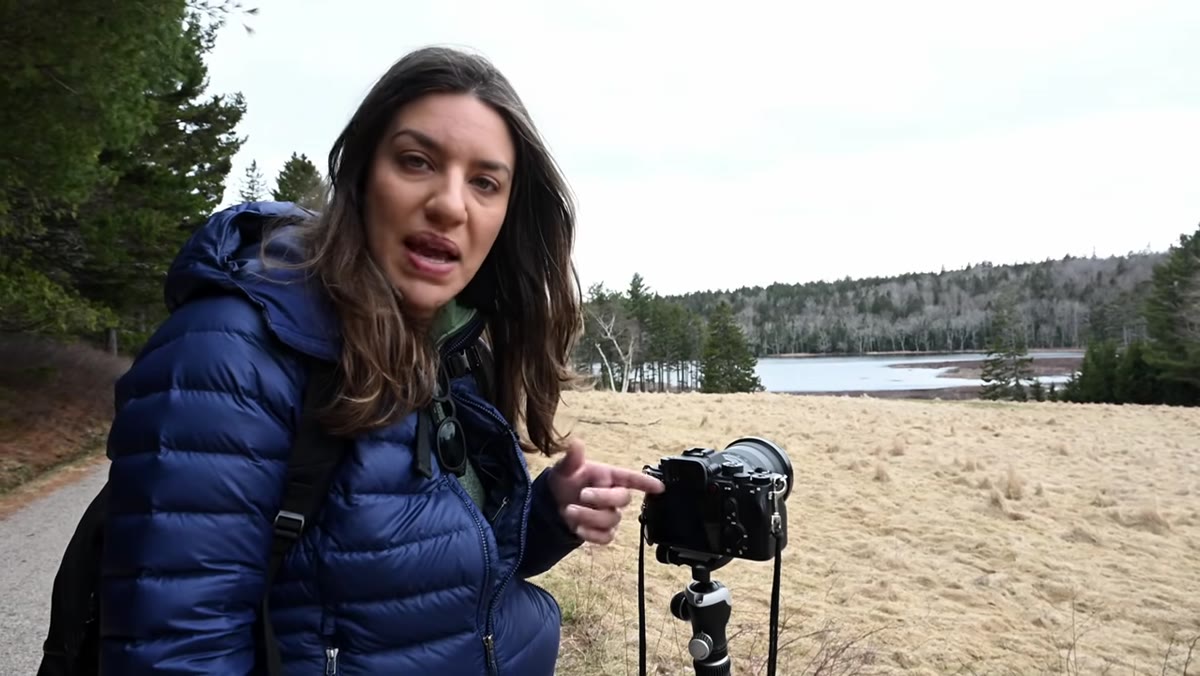
Chelsea spends time discussing Sony’s redesigned menu architecture on the Alpha 1, and this is worth taking seriously. Menus matter most when your hands are cold, your light window is closing, and you need to change a setting without digging through layers of submenus. Sony’s newer interface is more logically organized than the system it replaced, which had a reputation for burying critical settings in unexpected locations.
Caption: Sony Alpha 1 menu system shown on camera screen
Chelsea spends time discussing Sony’s redesigned menu architecture on the Alpha 1, and this is worth taking seriously. Menus matter most when your hands are cold, your light window is closing, and you need to change a setting without digging through layers of submenus. Sony’s newer interface is more logically organized than the system it replaced, which had a reputation for burying critical settings in unexpected locations.
My own approach is to program as many frequently used settings as possible to custom buttons before I leave the house, so I rarely need the menu in the field at all. But every system has limits on what can be customized, and the baseline menu logic matters when you hit those limits. Spend time with each camera’s menu in a camera store before you buy. Put it in a dark corner of the room and navigate by feel.
Step 5: Think Honestly About Versatility vs. Specialization
 Caption: Chelsea shooting with Sony Alpha 1 at sunrise on rocky beach
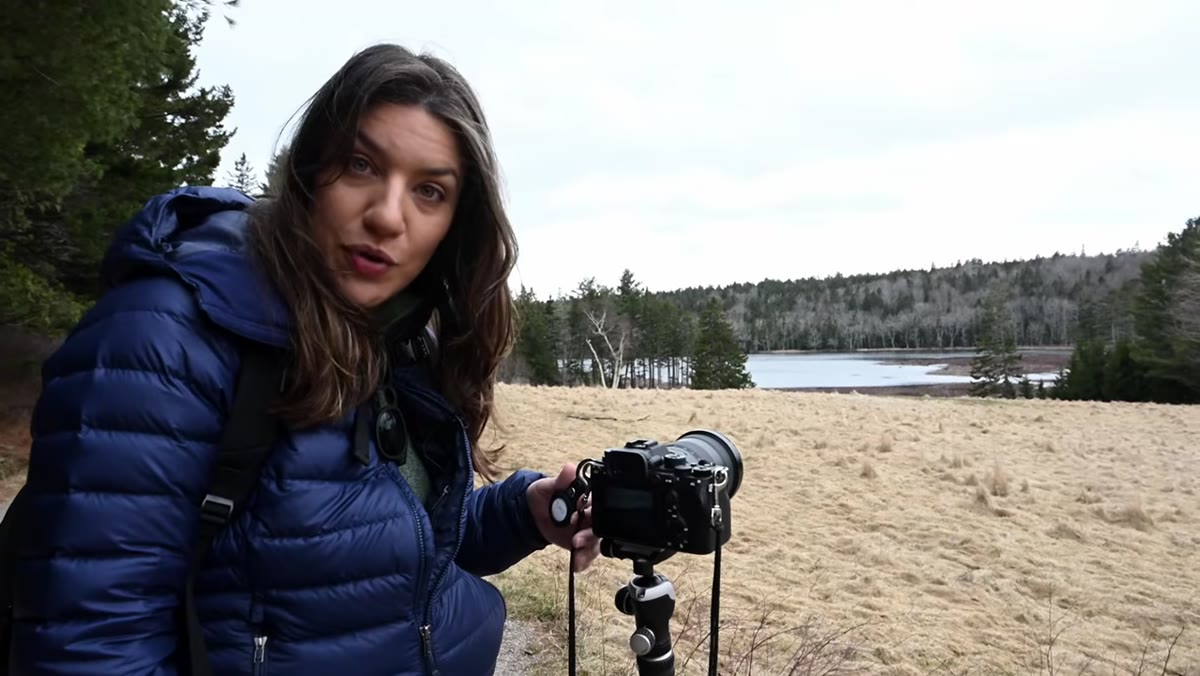
One of the sharpest observations in the video is the reason Chelsea is even considering the Alpha 1, despite not being primarily a sports photographer. The camera’s combination of 50 megapixels and excellent high-speed performance makes it a genuinely versatile tool - portraits, wildlife, landscapes, travel - without forcing you to compromise deeply in any direction.
Caption: Chelsea shooting with Sony Alpha 1 at sunrise on rocky beach
One of the sharpest observations in the video is the reason Chelsea is even considering the Alpha 1, despite not being primarily a sports photographer. The camera’s combination of 50 megapixels and excellent high-speed performance makes it a genuinely versatile tool - portraits, wildlife, landscapes, travel - without forcing you to compromise deeply in any direction.
For landscape photographers who also take on editorial travel work or occasional wildlife assignments, this versatility has real dollar value. You’re not buying a second body for a different job. The R5 occupies a similar middle ground, though with different ergonomics and a different ecosystem of glass. The Z9 leans harder into performance at the expense of portability. Know what you actually shoot in a given year, not what you imagine you might shoot someday.
What Twenty Years in the Field Adds to This Conversation
I still shoot a roll of film occasionally - not for nostalgia, but because it forces a different kind of discipline. You think more carefully before pressing the shutter when you have twelve frames instead of twelve hundred. That mindset carries over to how I evaluate gear. I ask whether a camera makes me think more clearly in the field, or whether it gives me so many options that I start hedging instead of committing.
The Sony Alpha 1 appeals to me for the same reason a well-edited kit appeals: it’s enough without being excessive. The Canon R5 sits in a comfortable middle position that will suit most landscape photographers who already shoot Canon. The Nikon Z9 is a serious tool that rewards serious volume shooters, but for a photographer who is making considered, deliberate images in wild places, it asks you to carry more than it gives back.
The single most important thing this video reinforced for me is that system weight is a creative decision, not just a physical one. Fatigue changes what you’re willing to hike to, how long you’ll wait for the light to change, and whether you come home with a frame worth keeping. Choose the kit your future self will still want to carry after the first two miles.
Watch the full tutorial on YouTube for Chelsea’s complete field footage and direct image comparisons between all three systems.
Comments
Leave a Comment