
Most Saturday mornings I’m up before four, coffee in hand, watching the sky through the kitchen window and deciding whether the light is worth the drive. But some mornings I stay in. The truck doesn’t move, the lucky hat stays on the hook, and I park myself with a second cup and go looking for photographers who see the world differently than I do. Not the ones the algorithm pushes at me automatically, the household names with a million subscribers, but the quieter voices doing genuinely interesting work in the field.
That search used to feel aimless until I watched this Watch the full tutorial on YouTube by Mark Denney, where he walks through his new favorite landscape photography YouTube channels of 2019. Mark approaches it less like a listicle and more like a photographer sharing notes after a long season of paying attention. He’s not ranking anyone. He’s describing what actually kept him watching, and for a working photographer trying to keep my eye sharp and my thinking fresh, that distinction matters.
What struck me most was the framework underneath the recommendations. Mark isn’t hunting for production value or subscriber counts. He’s looking for authenticity, for channels where the person behind the camera feels like a real photographer working through real problems. After twenty years of selling prints and running workshops, I’ve learned that the most useful thing another photographer can show you is their actual thought process, not a polished result. These channels, according to Mark, do exactly that.
Step 1: Understand Why the Algorithm Won’t Find These Channels For You
 YouTube algorithm concept explained, larger channels surfaced first
Before Mark names a single channel, he makes a point worth sitting with. YouTube’s recommendation engine is built to serve you what’s already popular. If you only let it run, you end up in a loop of the same ten creators. Finding genuinely fresh work requires deliberate searching, following one interesting video back to a full channel page, and being willing to spend time there before you decide whether it’s worth subscribing. Think of it the way you’d scout a new shooting location. You don’t just drive to the first pullout and call it done.
YouTube algorithm concept explained, larger channels surfaced first
Before Mark names a single channel, he makes a point worth sitting with. YouTube’s recommendation engine is built to serve you what’s already popular. If you only let it run, you end up in a loop of the same ten creators. Finding genuinely fresh work requires deliberate searching, following one interesting video back to a full channel page, and being willing to spend time there before you decide whether it’s worth subscribing. Think of it the way you’d scout a new shooting location. You don’t just drive to the first pullout and call it done.
Step 2: Start With Kim Grant for Calm, Location-Driven Storytelling
 Mark discussing Kim Grant’s channel style and Scottish landscape work
The first channel Mark recommends belongs to Kim Grant, a photographer based in Scotland. Her videos are on-location vlog style, meaning she takes you into the field with her rather than standing in front of a whiteboard. What Mark values here is her demeanor. She’s not performing for the camera. She talks through what she’s seeing and thinking the way a photographer would talk to another photographer standing next to her at the tripod.
Mark discussing Kim Grant’s channel style and Scottish landscape work
The first channel Mark recommends belongs to Kim Grant, a photographer based in Scotland. Her videos are on-location vlog style, meaning she takes you into the field with her rather than standing in front of a whiteboard. What Mark values here is her demeanor. She’s not performing for the camera. She talks through what she’s seeing and thinking the way a photographer would talk to another photographer standing next to her at the tripod.
For someone like me who runs field workshops, that naturalness is the hardest thing to teach and the most valuable thing to find in online content. Watch her with the sound up. Notice how she frames decisions verbally, why she chose this angle, what the light is doing, what she’s waiting for. That kind of narrated observation is a genuine education if you’re willing to receive it that way.
Step 3: Follow Henry Turner’s Career Transition as a Study in Commitment
 Mark describing Henry Turner leaving full-time job for landscape photography
The second recommendation is Henry Turner, based in Northwest England, who made the decision to leave a full-time career to pursue landscape photography professionally. Mark had watched him document that transition in real time. The channel mixes field vlogs with gear discussions and practical technique, which makes it a useful all-around resource. But the career shift is the thread worth following.
Mark describing Henry Turner leaving full-time job for landscape photography
The second recommendation is Henry Turner, based in Northwest England, who made the decision to leave a full-time career to pursue landscape photography professionally. Mark had watched him document that transition in real time. The channel mixes field vlogs with gear discussions and practical technique, which makes it a useful all-around resource. But the career shift is the thread worth following.
I remember what that kind of commitment feels like from the inside. When I stopped treating photography as a side project and started treating it as the work, everything changed, including how I prepared, how long I stayed at a location, and how seriously I took the failures. Watching someone navigate that transition in public, honestly and without a safety net, is more instructive than most technique videos because it shows you the whole shape of the decision, not just the pretty frames at the end.
Step 4: Use Rachel Lurch’s Channel to Study Atmosphere and Sound Design
 Mark discussing Rachel Lurch’s channel and use of music in videos
Rachel Lurch, shooting out of Ontario, Canada, gets singled out in part because of her consistent use of music in her videos. Mark mentions that almost every video has at least one strong track, and the pairing of sound to landscape imagery is deliberate. This is easy to dismiss as a production detail, but pay closer attention.
Mark discussing Rachel Lurch’s channel and use of music in videos
Rachel Lurch, shooting out of Ontario, Canada, gets singled out in part because of her consistent use of music in her videos. Mark mentions that almost every video has at least one strong track, and the pairing of sound to landscape imagery is deliberate. This is easy to dismiss as a production detail, but pay closer attention.
The way a photographer chooses to underscore their footage tells you something about how they experience a place emotionally, not just visually. When I’m in the field before dawn on the Deschutes River, the sound of moving water is as much a part of my orientation as the light. Photographers who think about atmosphere in their videos usually think about it in the field too. That translates to images that feel inhabited rather than just technically correct.
Step 5: Let the Channel Page, Not the Single Video, Be Your Measure
 Mark describing the feeling of watching multiple videos on a new channel
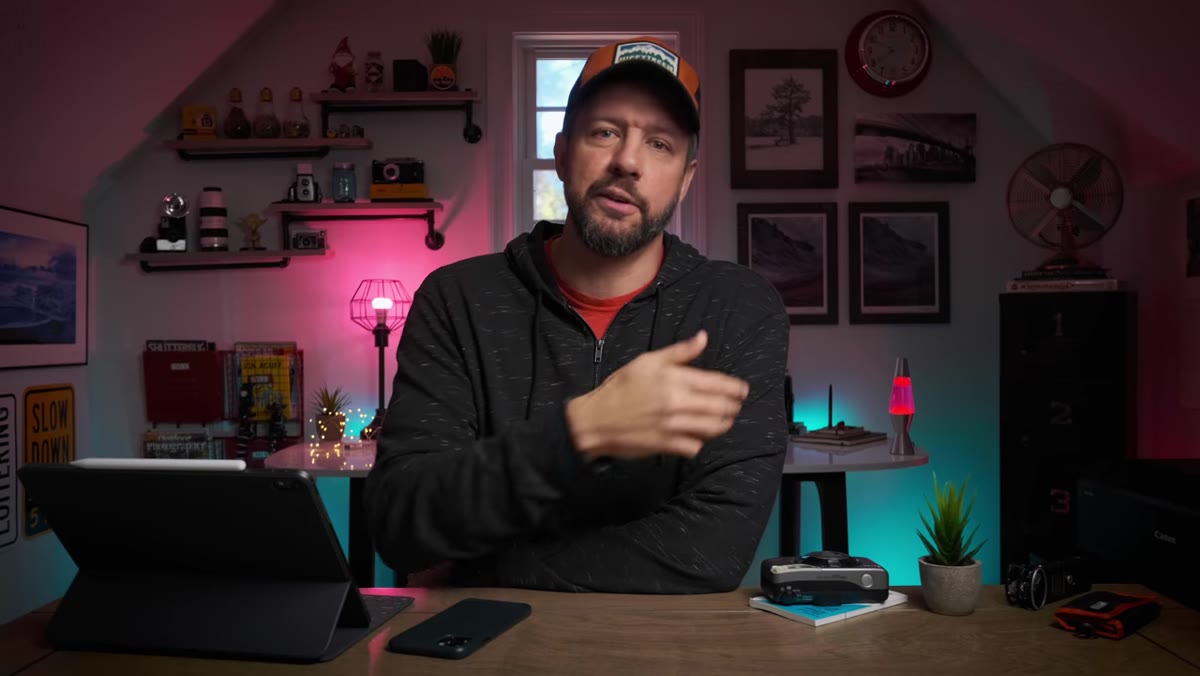
This is the practical step Mark builds the whole video around, even if he doesn’t state it as a rule. When you find a video you respond to, don’t subscribe immediately. Go to the channel page. Watch two or three more. See if the quality holds, if the perspective deepens, or if that first video was an outlier. Mark describes losing an hour this way on a Saturday morning, watching four or five videos in a row before realizing how much time had passed.
Mark describing the feeling of watching multiple videos on a new channel
This is the practical step Mark builds the whole video around, even if he doesn’t state it as a rule. When you find a video you respond to, don’t subscribe immediately. Go to the channel page. Watch two or three more. See if the quality holds, if the perspective deepens, or if that first video was an outlier. Mark describes losing an hour this way on a Saturday morning, watching four or five videos in a row before realizing how much time had passed.
That’s the right test. A single strong video can be luck or a one-time effort. A consistent body of work in the same direction is a voice. Subscribe to voices, not moments.
What I’d Add From My Own Experience
The channels Mark recommends share something beyond authenticity. They all show photographers working in conditions that didn’t cooperate, bad light, wrong timing, long waits with no guarantee of return. That matches what I know to be true. My best-selling print came from a two-day fog sit at a location six hours from home. I drove back with one usable frame. My mentor used to say the mountain doesn’t care about your schedule, and he was right. The photographers in these channels understand that. You can feel it in how they talk about waiting.
If you’re building a list of channels to follow, weight it toward people who show you the misses alongside the wins. Anyone can post their best day. The ones who post their worst days and come back anyway are the ones teaching you something real.
The single most valuable idea in Mark’s video is this: the algorithm optimizes for popularity, but your education as a photographer requires seeking out the unfamiliar. Set aside one Saturday morning a month, brew something strong, and go find a photographer the algorithm hasn’t handed you yet. The searching is part of the practice.
Watch the full tutorial on YouTube to hear Mark walk through each channel in his own words and see footage from the photographers he recommends.
Comments (4)
I tried this on a client project yesterday and the results were way better than expected.
Love how you break down complex stuff into manageable steps.
Quality content like this is rare. Keep it up.
Excellent tutorial. I'd add that from a photography standpoint, this technique is incredibly versatile.
Leave a Comment