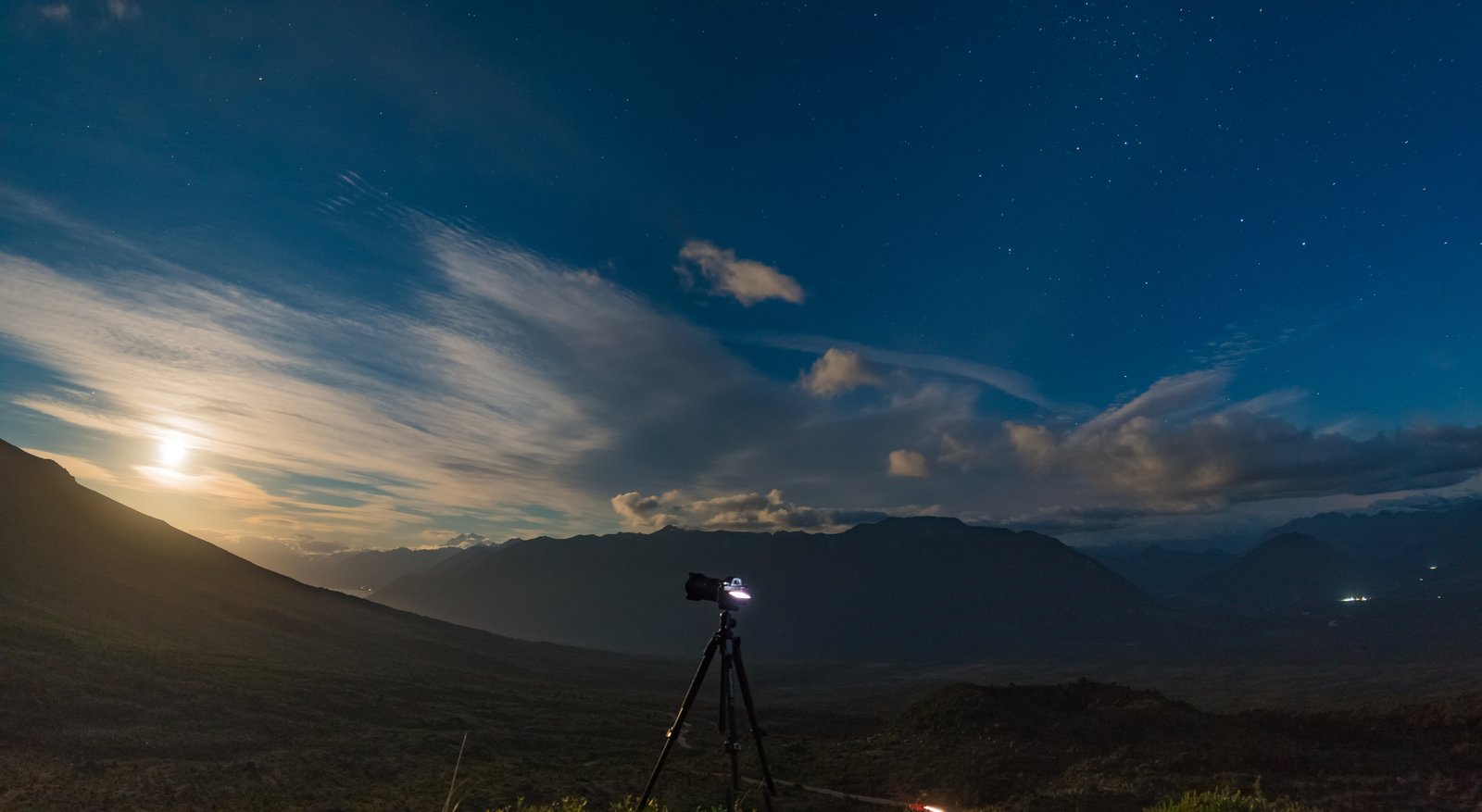
The first time I tried to photograph the Milky Way seriously, I drove out to the Oregon high desert, set up in the dark, and shot at ISO 6400 with a 30-second exposure because someone on a forum said that was the right way to do it. The images looked like someone had dragged a wet paintbrush across a black canvas. Smeared, noisy, directionless. I drove home at 3am thinking I just didn’t have the right gear. I had a full-frame camera and a 24mm f/1.8 lens. The gear wasn’t the problem.
The problem was that I was treating the night sky like a low-light challenge to be brute-forced, rather than a subject with its own logic.
Why the Sky Moves Faster Than You Think
The Earth’s rotation doesn’t stop being a problem just because you’re using a wide-angle lens. Stars trail. At 24mm on a full-frame sensor, the point at which a star starts to visibly streak depends on where in the sky you’re pointed and how pixel-dense your sensor is. The old “500 rule” (divide 500 by your focal length to get your maximum shutter speed) is outdated for modern high-resolution sensors. I use the NPF rule instead, which accounts for aperture and sensor pixel pitch. For my current body, a 24mm lens, and f/2, that works out to roughly 15-17 seconds before I start seeing elongation on stars near the celestial equator.
This matters because every second you shave off your exposure has to be compensated somewhere else: a wider aperture, a higher ISO, or image stacking. There is no free lunch at night.
The Settings I Actually Use in the Field
I shoot manual on everything, always have. Here’s where I typically land for a single-frame Milky Way capture: 15 seconds, f/1.8 or f/2 depending on the lens, ISO 3200 to 6400 depending on how dark the sky is and what I’m willing to manage in post. I shoot RAW at the highest bit depth my camera allows. The 14-bit files give me more room to pull shadow detail without the noise falling apart.
For moon phase, I plan around the new moon window, typically 3-5 days either side. A half moon will wash out the core of the Milky Way so thoroughly that no amount of processing recovers it. I use PhotoPills for planning. It costs around $12 and is the most useful $12 I’ve spent in photography. I’ll enter a location, set a date, and watch the augmented reality view show me exactly where the Milky Way core will sit relative to my foreground at any given hour. I plan my compositions before I ever drive out.
Speaking of foregrounds: the sky alone is rarely enough. I look for something within 20-30 feet that has strong graphic form. A gnarled juniper, a basalt rim, a reflection in a still pond. The foreground grounds the image and gives the viewer a place to stand.
Stacking vs. Single Frame: Know When Each Makes Sense
If noise is your main issue, image stacking is more effective than any noise reduction plugin. Shooting 15-20 frames of the same sky and median-stacking them in Sequator (free on Windows) or Starry Landscape Stacker (around $40 on Mac) reduces random noise without softening star edges the way Lightroom’s luminance slider does. The math is straightforward: stacking 16 frames gives you roughly a 2-stop improvement in signal-to-noise ratio. That’s significant.
But stacking only works when your foreground is static and your composition isn’t changing. I use it for dedicated Milky Way images. When I’m after a single decisive frame where the light is transitioning, say, the last 20 minutes of astronomical twilight when the sky is still deep blue and the stars are just becoming visible, I shoot a single exposure and process it carefully. That transitional window is underused and undervalued. The Milky Way doesn’t need to be photographed against pure black. Blue-hour skies add color separation that makes the core pop in a way that dead-of-night images often don’t.
The Night I Learned to Let the Location Lead
A few years ago I drove out to the Alvord Desert in southeastern Oregon for a clear-sky forecast. Four hours of driving. I’d pre-planned the shot in PhotoPills down to the minute. When I arrived, a thin layer of cirrus had moved in. Not thick enough to block the stars entirely, just enough to blur them and add a diffuse glow around the Milky Way core.
I almost packed up. Instead I stayed, adjusted my expectations, and started working the foreground differently. The cirrus was doing something interesting to the light. I ended up making a series of images I’d never planned for, with a soft, almost dreamlike quality that I still license regularly. My mentor, years before, had told me the mountain doesn’t care about your schedule. I thought I understood that. Standing in the Alvord at 1am watching the clouds I’d driven four hours to avoid, I actually understood it.
The One Variable That Matters More Than Gear
Dark sky access is the limiting factor in night photography, not the camera body. Light pollution maps at lightpollutionmap.info will show you the Bortle scale rating for any location on Earth. I try to get to Bortle 3 or below for Milky Way work. Bortle 4 is workable but requires more processing. Bortle 5 and above, the core loses contrast against the sky background in a way that’s very difficult to recover convincingly.
You can buy a better lens. You can’t buy a darker sky. Drive farther.
Comments (3)
My workflow just got 10x faster. Not even kidding.
The tip about what the milky way teaches you was the missing piece for me. Thank you.
Clear and practical. No fluff. Appreciate that.
Leave a Comment