I’ve been shooting landscapes for twenty years and I still catch myself defaulting to the wide angle when I’m near water. It’s almost muscle memory at this point. Wide angle, foreground interest, dramatic sky. It’s a formula that works, but lately it’s been feeling like a rut.
A few weeks ago I was out before sunrise along the Deschutes, trying to make something interesting out of a section of river I’ve photographed dozens of times. Nothing was clicking. The compositions felt familiar in a bad way. I pulled out my 70-200 almost on a whim, and something shifted. The compression, the intimacy, the way the telephoto isolates just one quiet bend of water and ignores everything else. I came home with images that felt genuinely new to me.
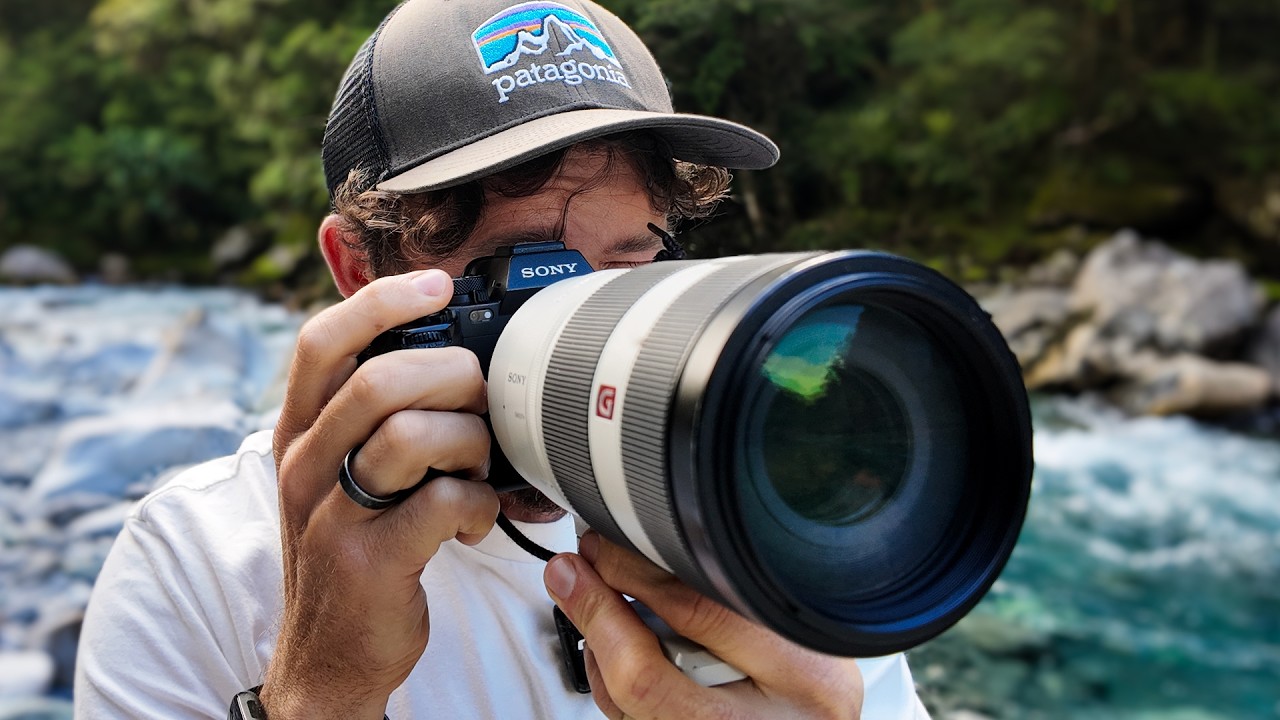
That experience sent me looking for more thinking on the subject, which is how I landed on this William Patino tutorial on telephoto landscape photography. He takes you into the field and works through exactly this approach: using longer focal lengths to create calm, compressed water scenes with slow shutter speeds. It confirmed some instincts and corrected a few habits I’d let get sloppy.
What the Telephoto Actually Does to Water
The core insight Patino demonstrates is that a telephoto lens doesn’t just reach farther. It collapses distance between elements in the frame, which changes the way moving water reads in a photograph. With a wide angle, flowing water can feel chaotic because the frame contains so much of it. With a telephoto, you’re selecting a narrow slice of the scene. The water fills more of the frame, and when you add a slow shutter, that silky motion reads as texture rather than noise.
He works around the 200mm range for most of the shots in the video, though the specific focal length matters less than the principle: find the section of water that tells the story on its own, and let the lens cut out everything that complicates it.
The Exposure Settings That Make This Work
Patino is specific about settings in a way I appreciate. He’s not giving you a starting point and wishing you luck. For the slow shutter look on water in daylight, he’s working with shutter speeds in the range of half a second to several seconds depending on water speed and the mood he’s after. To get there in bright conditions, you need to stack a few things.
First, drop your ISO as low as your camera will go. He’s shooting at base ISO, which on most modern mirrorless systems is ISO 64 or 100. Second, close the aperture down. He’s typically at f/11 to f/16 in these scenes, which also helps maximize depth of field across a compressed telephoto frame. Third, and this is the piece a lot of people skip, use a solid ND filter. Patino recommends a 6-stop or 10-stop ND depending on how much light you’re fighting. A 10-stop filter in full sun can take a 1/500s exposure down to roughly 2 seconds. That’s the ballpark you want.
Tripod is non-negotiable here. At 200mm with a multi-second exposure, any vibration destroys the shot. He also uses a remote shutter release and enables mirror lockup or electronic shutter to eliminate camera shake from the mechanism itself. Small details that matter enormously at this shutter speed and focal length.
Finding the Composition Before You Set the Exposure
One thing Patino does in the field that I think gets overlooked: he scouts the composition handheld before he ever sets up the tripod. He walks the bank, holds the camera up, and looks for the lines and the light. Only when he’s committed to a frame does he plant the legs.
This sounds obvious but it changes your workflow in a useful way. Telephoto compositions are easy to rush because the lens feels like it’s doing the work for you. It isn’t. You still need a clear subject, a sense of depth, and some leading element that pulls the eye through the frame. Patino looks for curves in the water, reflections, or a single rock or log that anchors the foreground within the narrow field of view. The compression will handle the drama. Your job is to give it something worth compressing.
Where I’d Push This Technique Further
Patino shoots in calm, gentle light, and his results reflect that. Quiet tones, meditative pacing. That aesthetic suits his vision and the images are genuinely beautiful. But I’ve found that this same telephoto-plus-slow-shutter approach gets interesting in harsher conditions too, specifically at golden hour when the light is directional and the water picks up warm tones in the silked-out areas. The contrast between a sharp, lit rock face and a glowing streak of blurred water underneath it is something the wide angle can’t replicate the same way.
The one place this technique falls apart for me is in wind. At 200mm and two seconds, any moving vegetation in the frame turns into a blur that looks like a mistake rather than an intention. Patino’s shooting mostly open water, so he avoids this. If you’re working near trees or grasses, either wait for a still moment or frame them out entirely.
The Thing Worth Carrying Into Your Next Shoot
The telephoto isn’t a specialty tool you pull out for wildlife and put away again. It’s a different way of seeing the same landscape, and for slow-shutter water work, it often produces quieter, more focused images than a wide angle will.
Watch Patino’s full video for the visual demonstration. Seeing how he physically moves through the scene and adjusts the frame in real time is worth more than any written breakdown.
Comments (3)
Clear and practical. No fluff. Appreciate that.
Finally someone explains this in a way that actually makes sense.
Never thought of approaching it this way. Really creative.
Leave a Comment