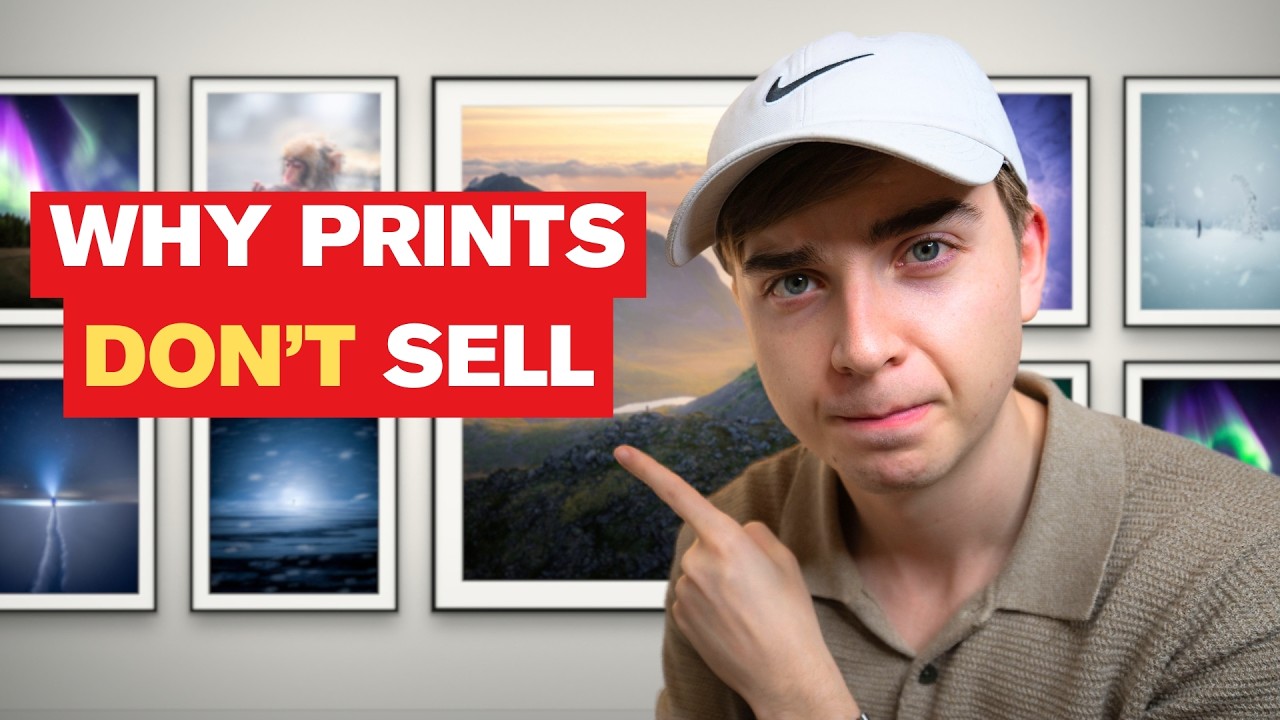
I’ve been waking up at 4am for two decades to chase light. I’ve stood in freezing rivers in January, driven through the night to catch a specific angle of alpenglow, and spent entire weekends in the field chasing a single image. For most of that time, I assumed the logical endpoint of all that work was a print shop. Shoot beautiful landscapes, hang them on a virtual wall, and wait for the world to notice. It sounds clean and romantic. It is neither of those things in practice.
So when I came across Watch the full tutorial on YouTube from Hugo Korhonen, a Finnish photographer who has built a location-independent photography business, I sat with it for a while. Not because his perspective is radical, but because he says plainly what a lot of working photographers quietly know and rarely admit: for most of us, selling prints is a trap dressed up as freedom. Hugo breaks down exactly why that is, who the rare exceptions are, and what to do instead. What follows is my own walkthrough of his framework, run through twenty years of hard-won field experience.
Step 1: Diagnose what “freedom” actually means to you
 Hugo introduces the idea that print-selling feels like freedom
Before you build any business model around your photography, you need to get honest about what you’re actually chasing. Hugo opens by challenging a definition most of us absorb without questioning: that freedom means shooting whatever you want and then selling it as prints. It sounds logical. It is not a business model. It is a hope.
Hugo introduces the idea that print-selling feels like freedom
Before you build any business model around your photography, you need to get honest about what you’re actually chasing. Hugo opens by challenging a definition most of us absorb without questioning: that freedom means shooting whatever you want and then selling it as prints. It sounds logical. It is not a business model. It is a hope.
Ask yourself whether you want creative freedom, financial predictability, location independence, or some combination. Your answer determines your entire strategy. Conflating all three into “I’ll sell prints” is where most photographers get stuck before they even start.
Step 2: Understand the mechanics of art sales before you commit to them
 Hugo explains why most photographers won’t succeed selling prints
Hugo is clear that print sales are a legitimate income stream for specific people in specific situations. But the mechanics of selling art objects work against most photographers. A print sale is a one-time transaction. There is no recurring revenue. No retainer. No predictable monthly income. You sell a piece, and then you need to find the next buyer from scratch.
Hugo explains why most photographers won’t succeed selling prints
Hugo is clear that print sales are a legitimate income stream for specific people in specific situations. But the mechanics of selling art objects work against most photographers. A print sale is a one-time transaction. There is no recurring revenue. No retainer. No predictable monthly income. You sell a piece, and then you need to find the next buyer from scratch.
For seven months early in his career, Hugo had an online print shop and made zero sales. Zero. He was posting work, showing up, and refreshing his inbox hoping for a notification. I know that feeling intimately. I ran a print store for three years alongside everything else, and the income was erratic enough that I could never plan around it. Good months felt like luck. Bad months felt like failure. Neither feeling was particularly useful.
Step 3: Identify whether you are actually positioned to sell prints
 Hugo lists who should and shouldn’t sell prints
Hugo draws a useful line here. If you already have a large, engaged audience on Instagram, YouTube, or elsewhere, then a print shop can be a sensible supplemental income. Your audience already trusts you. They already want a piece of what you do. A print becomes an extension of that relationship.
Hugo lists who should and shouldn’t sell prints
Hugo draws a useful line here. If you already have a large, engaged audience on Instagram, YouTube, or elsewhere, then a print shop can be a sensible supplemental income. Your audience already trusts you. They already want a piece of what you do. A print becomes an extension of that relationship.
If you do not have that audience yet, and you are hoping print sales will fund the lifestyle that lets you build that audience, you have the sequence inverted. You need the platform before the shop, not the other way around. Most photographers set up the shop first and spend years wondering why it does not convert.
Step 4: Recognize the income volatility problem for what it is
 Hugo describes the rollercoaster of monthly print income
Hugo had a five-figure month as an 18-year-old selling his photography online. By any measure, that is remarkable. But he is honest about what came next: months that were barely four figures, then three, with no pattern he could predict or rely on. One strong month followed by a drop with no clear explanation.
Hugo describes the rollercoaster of monthly print income
Hugo had a five-figure month as an 18-year-old selling his photography online. By any measure, that is remarkable. But he is honest about what came next: months that were barely four figures, then three, with no pattern he could predict or rely on. One strong month followed by a drop with no clear explanation.
That volatility is not a personal failing. It is a structural feature of art sales. Buyer demand for decorative prints fluctuates with season, with algorithm reach, with trends you cannot control. When your rent depends on that number being consistent, the creative freedom you were chasing disappears. You start shooting what you think will sell rather than what compels you to get up before dawn.
Step 5: Reframe your photography skill as a deliverable service, not just a product
 Hugo pivots to alternative income models for photographers
The shift Hugo advocates is moving from selling art objects to selling your expertise and your eye as a service. This could mean working with clients directly, running education, or building retainer relationships. The specifics will vary by photographer, but the underlying principle is the same: service-based income can be predictable. Someone pays you on a schedule for something they need consistently. That is a foundation you can build a life on.
Hugo pivots to alternative income models for photographers
The shift Hugo advocates is moving from selling art objects to selling your expertise and your eye as a service. This could mean working with clients directly, running education, or building retainer relationships. The specifics will vary by photographer, but the underlying principle is the same: service-based income can be predictable. Someone pays you on a schedule for something they need consistently. That is a foundation you can build a life on.
This is not about abandoning your artistic vision. It is about funding it more reliably. I still sell prints. They still sell erratically. But they are not what keeps the lights on, and that changes everything about how I approach the work.
Step 6: Build toward freedom by solving someone else’s problem first
 Hugo describes the path to a freedom-based photography business
Hugo’s broader point, and the one I think gets missed when people skim this kind of advice, is that freedom as a photographer is downstream of usefulness to someone else. Whether that is a business that needs compelling imagery, a workshop participant who wants to learn how to read light, or an editorial client on retainer, your photography generates consistent income when it solves a specific problem for a specific person.
Hugo describes the path to a freedom-based photography business
Hugo’s broader point, and the one I think gets missed when people skim this kind of advice, is that freedom as a photographer is downstream of usefulness to someone else. Whether that is a business that needs compelling imagery, a workshop participant who wants to learn how to read light, or an editorial client on retainer, your photography generates consistent income when it solves a specific problem for a specific person.
The photographer who shoots whatever they want and waits for the market to find them is playing a very long, very expensive game. The photographer who identifies what their skills are worth to someone and builds an offer around that gets to shoot what they want with far less financial anxiety behind the lens.
What twenty years in the field adds to this
Hugo’s framework is sound, and I would sign my name to most of it. The one caveat I would add is that print sales can serve a different purpose than income: they can serve as proof. A well-placed sale, a strong gallery showing, a print that ends up in a client’s office, these things carry social weight. They validate the work in a way that a client invoice does not.
I once drove six hours to a location, sat in fog for two days, and came home with a single usable frame. That image became my best-selling print. It has also opened more doors in conversations than any marketing I have ever done. So I would not abandon the print entirely. I would just stop treating it as a business plan.
The single most important thing Hugo’s tutorial clarified for me: the goal is not to monetize your art. The goal is to build income that protects your art from financial pressure. Those are different problems with different solutions, and most photographers spend years solving the wrong one.
Watch the full tutorial on YouTube and hear Hugo walk through this directly. His perspective as someone who actually reached five-figure months selling prints and still walked away from that model is worth your time.
Comments
Leave a Comment