I spent the better part of last autumn frustrated with a series of shots from the Cascades. Technically, they were fine. Sharp, well-exposed, good light. But something was off. They felt like records of a place rather than experiences of one. The viewer’s eye had nowhere to go. I kept cropping and re-exporting, thinking it was a processing problem, but the problem was earlier than that. The problem was in how I was building the frame before I pressed the shutter.
That friction is what made me stop and spend real time with this composition tutorial from William Patino. I’ve been shooting landscapes full-time for two decades, and I still find value in sitting with another working photographer’s framework, not because I’ve forgotten the fundamentals, but because a good teacher can make you see what you’ve stopped noticing.
What “Balancing a Frame” Actually Means in Practice
One of the core ideas Patino works through is frame balance, and he’s specific about it in a way that’s useful. Balance doesn’t mean symmetry. It means that the visual weight on either side of your frame, or top and bottom, feels intentional rather than accidental.
He walks through the idea of reading a scene in terms of mass. A dark boulder carries more visual weight than an open sky of the same size. A cluster of trees on the left needs something, even something small, on the right to keep the frame from tipping. In practice, this means slowing down before you raise the camera and asking: where is the weight, and where is the emptiness?
I’ve started doing this as a deliberate step at each location. I stand still, look at the scene without the camera, and mentally divide it into quadrants. Where is the heaviest visual element? Where is there negative space? Then I ask whether that relationship is doing something interesting or just happening by default.
Leading the Eye Without a Foreground Gimmick
The second technique Patino covers is directional flow, how you guide a viewer’s eye through the image rather than letting it land somewhere random and leave. He’s clear that this doesn’t require a winding river or a classic S-curve road. Any edge, tonal shift, or line of contrast can serve as a lead if you position yourself to use it.
What he emphasizes is that the lead needs to go somewhere. An edge that runs out of frame at the bottom-left and points toward nothing has done half the job. You want the viewer to travel through the frame and arrive at the subject with some sense of journey. The path and the destination both matter.
In terrain without obvious leading lines, like a wide coastal flat or an open meadow, he suggests using light itself as a directional element. A streak of sun across grass, a shadow edge, a band of mist. These carry the eye just as reliably as a river if you learn to see them.
Building Depth Across Three Zones
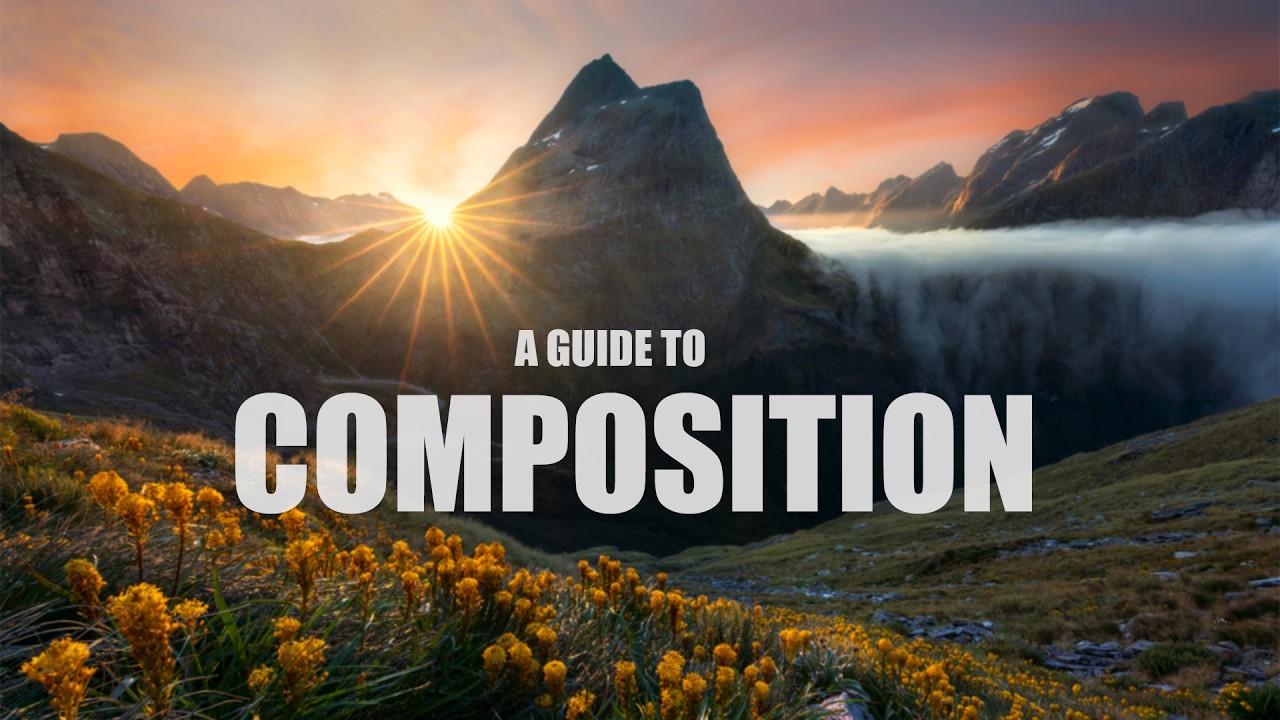
This is the section I found most immediately useful. Patino breaks the frame into foreground, middle ground, and background and argues that a strong landscape image has something working in each zone, not necessarily a dramatic object, but some element that gives the eye a reason to travel that distance.
The foreground anchors the viewer in the scene. The middle ground creates the sense of traverse. The background gives the image somewhere to rest. When one of those zones is dead, the image collapses into a postcard. You’re looking at it rather than moving through it.
His practical fix is to physically move. Lower, closer, wider. Most photographers, including me on tired mornings, tend to shoot from standing eye level at a comfortable distance. Getting low changes the foreground completely. A patch of frost, a line of rocks, a shadow shape become structural elements instead of incidental texture.
Where This Framework Gets Complicated
I’ll add one honest caveat from my own experience. This three-zone model works beautifully in environments with spatial depth, mountains, valleys, layered ridgelines. It works less cleanly when you’re shooting compressed scenes: a tight canyon wall, a fog-blanketed lake where there is no visible background, a scene where the drama is entirely in the sky.
In those situations, I’ve found that leaning into two-zone tension, a strong foreground against a dominant sky, or a single bold graphic element against emptiness, can be more honest than forcing a depth structure the scene doesn’t have. The framework is a starting point, not a rule. The camera doesn’t know what the rules are, and neither does the light.
This is something I think about a lot when I’m shooting in conditions that refuse to cooperate. My mentor used to say the mountain doesn’t care about your schedule, and he was right. Sometimes the scene gives you one thing, and your job is to find the composition inside that constraint rather than wish for a different scene.
The Habit That Changes How You See
The single most transferable thing in Patino’s tutorial is the practice of reading the frame before you shoot, not just reacting to light and beauty, but actively analyzing weight, direction, and depth as a repeatable step. Composition isn’t inspiration. It’s a skill you build through deliberate attention, and the framework he lays out gives you a checklist you can run in under a minute at any location.
Watch the full video for the visual demonstrations. He walks through real examples in a way that shows the before-and-after clearly, and seeing it in motion makes the spatial concepts stick faster than any description can.
Watch the tutorial here on YouTube
Comments
Leave a Comment