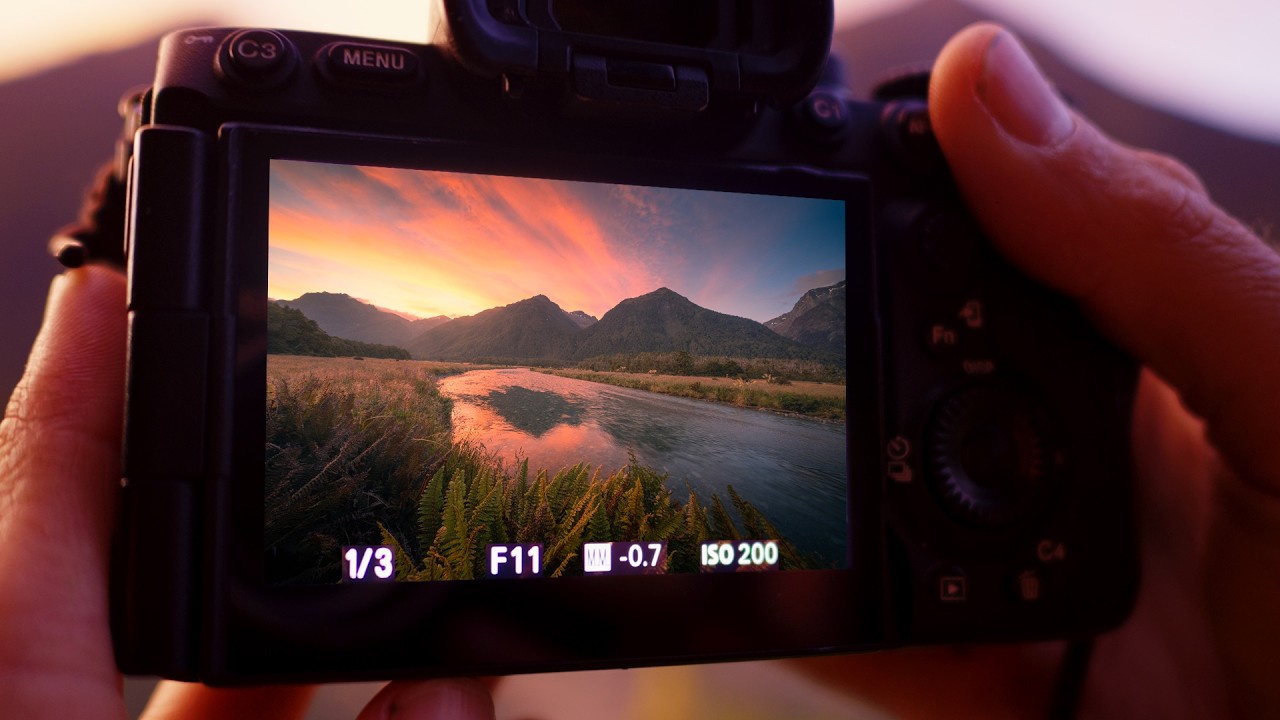
I’ve been shooting sunsets for two decades. I’ve stood in sagebrush fields outside Bend at temperatures that make your fingers stop working, waited out clouds that looked promising and then didn’t deliver, and driven to locations on a gut feeling more times than I can count. You’d think by now I had sunset composition dialed in.
But a few weeks ago I was reviewing a batch of golden hour images and something felt off. Technically clean. Properly exposed. And somehow flat. The light was doing everything right and my frames weren’t keeping up with it. That’s the particular frustration of experience: you know something is wrong but you’ve lost the fresh eyes to see exactly what.
That’s when I sat down with this tutorial from William Patino on color and light in landscape photography. I wasn’t looking for a beginner’s rundown. I was looking for a framework to pressure-test my own habits. I found one.
The Core Problem: A Frame That Doesn’t Know Where It’s Going
Patino’s central argument is straightforward but easy to overlook when you’re chasing light: a strong composition isn’t just about what’s in the frame, it’s about where the eye enters, where it travels, and where it rests. Without intention on all three, you get images that are visually busy but emotionally inert. The viewer’s eye bounces around and exits without landing anywhere meaningful.
He breaks this down into a working framework built around balance, lead lines, and depth. Not as abstract concepts but as active decisions you make before you raise the camera.
How to Actually Balance a Frame in the Field
Balance, as Patino explains it, isn’t symmetry. It’s visual weight distributed across the frame so neither side collapses the composition toward itself. A heavy foreground element on the left needs something on the right to hold tension with it, even if that something is negative space or a band of color on the horizon.
The practical move he recommends: before shooting, scan the frame in sections. Left third, center third, right third. Identify where the visual weight is sitting. If it’s all stacked on one side, either reposition or find a foreground element on the opposing side to create counterbalance. This takes about fifteen seconds and it changes what you see.
I tested this on my next outing. Same location I’d been frustrated with. Same light conditions. By deliberately scanning thirds before shooting, I caught myself defaulting to a left-heavy composition three times in a row. I didn’t know I was doing it.
Leading the Eye Without Forcing It
Patino is precise about lead lines in a way that separated this tutorial from the generic advice I’ve absorbed over the years. His point is that a lead line needs to serve the subject, not compete with it. A road, a riverbank, a ridge line: all of these can pull the eye toward the light source or toward a primary point of interest. The failure mode is a lead line that leads to nothing, or worse, leads the eye out of the frame entirely.
His fix is to trace the line with your finger before shooting. Follow it from the bottom of the frame toward the horizon. If your finger exits the frame on the side before it reaches the subject, the line is working against you. Reframe so the line terminates at or near the strongest area of light or compositional interest.
This is the kind of physical, tactile check that I’d stopped doing because it felt basic. Turns out I needed it.
Building Depth With Foreground, Mid-Ground, and Distance
The section I found most useful was his breakdown of layering depth into three distinct planes: foreground, mid-ground, and background. Patino’s argument is that all three need to be present and distinct for a landscape image to feel three-dimensional rather than like a postcard.
Foreground gives the viewer a point of entry. Mid-ground creates the journey. Background, usually where the sky and light are doing their work, provides the destination. He recommends looking for textures in the foreground that echo or contrast the textures in the background. A rough volcanic rock field in the foreground against a smooth gradient sky. A still pool reflecting the same colors burning in the clouds above. The frame becomes a conversation between layers rather than a single-plane record of a scene.
Practically: he suggests getting lower than feels comfortable. Most photographers stand at eye level by default. Dropping to knee height or lower exaggerates the foreground, pulls the layers apart, and adds the sense of being inside the scene rather than observing it from a distance.
Where I’d Push Back: When Structure Gets in the Way of the Moment
Patino’s framework is excellent and I use it. But I want to offer one honest caveat from my own experience.
There are moments, specific, rare moments, when the light moves so fast and changes so completely that running through a compositional checklist is the wrong instinct. I’ve stood in the Cascades and watched a cloud break send a single shaft of light across a ridge for maybe forty seconds. In those moments, the best images I’ve ever made came from reacting, not analyzing.
The framework Patino teaches is something you internalize over time until it operates below the level of conscious thought. Right now, if you’re still building that muscle memory, use his system deliberately and methodically. But the goal is to reach a point where your eye already knows what it’s looking for before you lift the camera.
That’s where the real work is.
The single most important idea in this tutorial is one Patino returns to throughout: every element in the frame needs a job. If you can’t say what role something is playing in the composition, it probably shouldn’t be there. Watch the full video for his visual demonstrations of these principles in action. They’re much easier to see than to read.
Comments
Leave a Comment