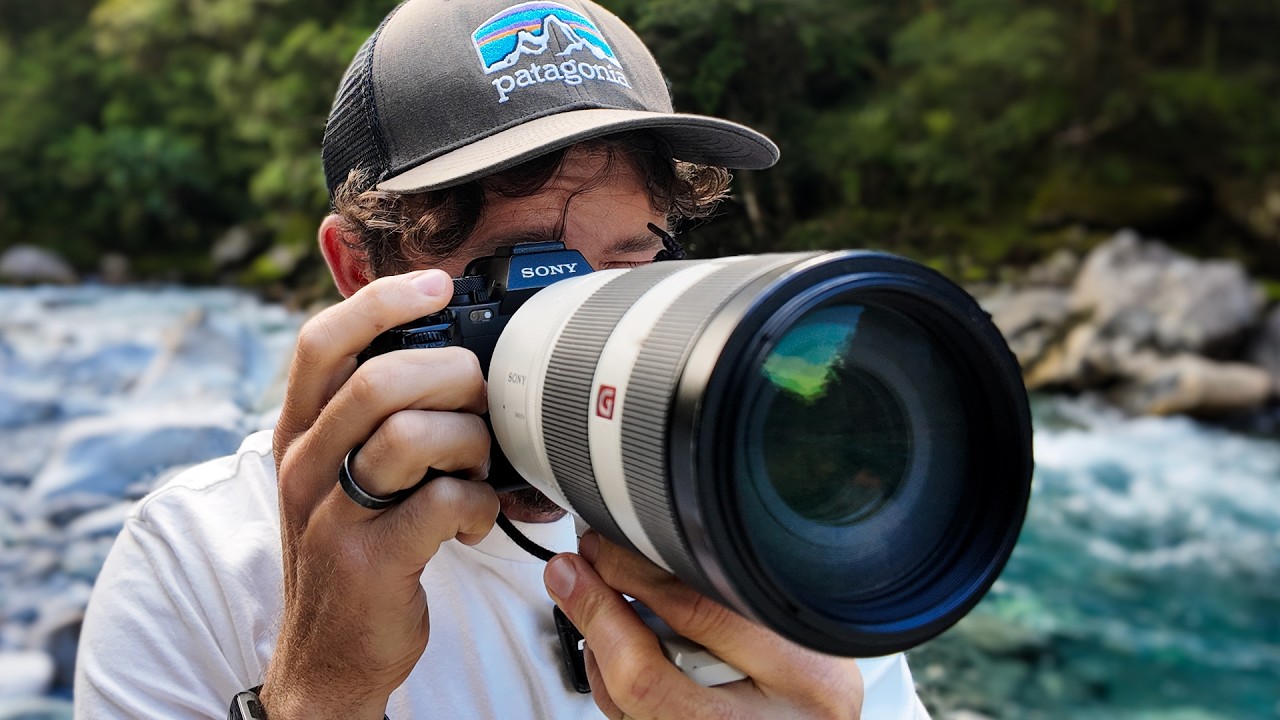
I’ve been shooting landscapes full-time for two decades, and I still fall into the wide-angle trap. It’s reflexive. Big scene, big sky, wide lens. You reach for the 16-35mm the way some people reach for their phone. But lately I’ve been forcing myself to think differently about compression, intimacy, and what “landscape” actually means when you strip away the drama of a grand vista.
That question got sharper for me after watching William Patino work through this tutorial on telephoto landscape photography. He’s out in the field, not in a classroom, and he’s making the case that a long lens isn’t just for wildlife or sport. It’s a tool for editing the world down to what matters.
The Problem With “More” in a Frame
The wide-angle instinct makes sense on the surface. You’re standing in front of something enormous and you want to capture all of it. But “all of it” is often the enemy of a strong image. Wide lenses in landscape work can produce photographs that feel like records rather than pictures. Everything included, nothing emphasized.
A telephoto lens solves this by forcing a choice. You can’t include everything. At 200mm or 300mm, you’re selecting a slice of the scene, and that selection is the composition. Patino’s approach leans into this deliberately, using the lens to isolate sections of moving water and create images that feel contemplative rather than grand.
What Patino Is Actually Doing in the Field
In this tutorial, Patino is working with water, specifically looking for sections where the movement is smooth enough to reward a slow shutter speed. The telephoto does two things here simultaneously. It compresses the foreground and background, making the water texture feel layered and dense. And it allows him to exclude shorelines, debris, or any elements that would break the calm mood he’s after.
His shutter speeds are running long, in the range of several seconds, which turns any surface movement into that familiar silk-and-mist effect. To get there without blowing the exposure, he’s stopping down his aperture and, critically, using a solid tripod setup. There is no version of this technique that works handheld. The slightest movement at a 2-second exposure at 200mm will turn your water into a blurred mess rather than a smooth one.
His approach to composition here is worth noting specifically. He’s not hunting for a single focal point and centering it. He’s looking at the relationship between tonal zones. Darker water against lighter water, shadow against reflected light. The telephoto compresses those zones together and the long exposure smooths the transitions between them. The result is something close to an abstract, but it still reads as water, still reads as a real place.
For settings, think in this range as a starting point: ISO as low as your camera allows, aperture between f/8 and f/16 depending on depth of field needs, and shutter speed determined by how much motion you want to record. A 2-second exposure will give you visible silkiness. Four seconds or longer pushes toward full abstraction. Use a remote shutter release or your camera’s timer to eliminate any vibration from the shutter press itself.
The Role of Light in Making This Work
Patino is out in soft, diffused light, and that’s not an accident. Harsh directional sun creates hot spots on water that expose at different rates than shadow areas. What you end up with is a frame that looks blown out in patches, with the dark areas blocking up. Flat, even light, the kind you get on overcast mornings or in open shade, gives the water a consistent tonal range that a long exposure can handle gracefully.
This is one of those techniques where the conditions matter as much as the settings. I’ve tried to force this approach on bright sunny days with a 10-stop ND filter and the results are technically correct but emotionally flat. The quality of light and the quality of the water’s surface movement have to be working together.
Where I’d Push Back, or at Least Push Further
I love this approach, but there’s a version of it that can start to feel formulaic. Once you know the recipe, silky water plus telephoto compression plus soft light, you can produce pleasant images indefinitely without really seeing anymore. I’ve been guilty of that. You find a section of river that works, you set up, you nail the exposure, and you leave with a portfolio image that looks like every other portfolio image of the same genre.
The place I’ve started to take this further is in shooting during transitional weather, not just overcast but actively changing. A storm moving out, light breaking through cloud in one small patch, the water color shifting from gray to green in a matter of minutes. The telephoto isolates a small enough section of the scene that these micro-changes in light and tone become the subject. You’re not documenting a place anymore. You’re documenting a moment in that place.
The risk is that most of those frames don’t work. But the ones that do are harder to replicate and more personal for it.
The Lens as an Editing Tool
The most useful reframe I took from Patino’s tutorial is thinking of the telephoto as an editing decision rather than a reach decision. You’re not using it because the subject is far away. You’re using it because it removes what doesn’t belong. That shift in thinking, from capture to edit, changes how you walk a location and what you’re looking for when you arrive.
That’s the takeaway worth sitting with. The longest lens in your bag might be your most disciplined compositional tool.
Watch William Patino’s full tutorial for the visual demonstration of how this plays out in real conditions. Seeing him move through the scene and evaluate different sections of water is the part that translates directly to fieldwork in a way that a written breakdown can’t fully replicate.
Comments
Leave a Comment