I came back from three weeks in the Cascades last fall with about four hundred frames I was genuinely excited about. Dramatic ridgelines, alpenglow hitting volcanic peaks, the kind of light that stops you mid-step. Then I drove two hours west to the Oregon coast for a quiet weekend and came home with almost nothing. Not because the light was bad. Because I couldn’t see it anymore. My eye had recalibrated to spectacle, and the soft kelp-grey morning fog rolling through the shore pines read as nothing. Blank. Not worth the tripod.
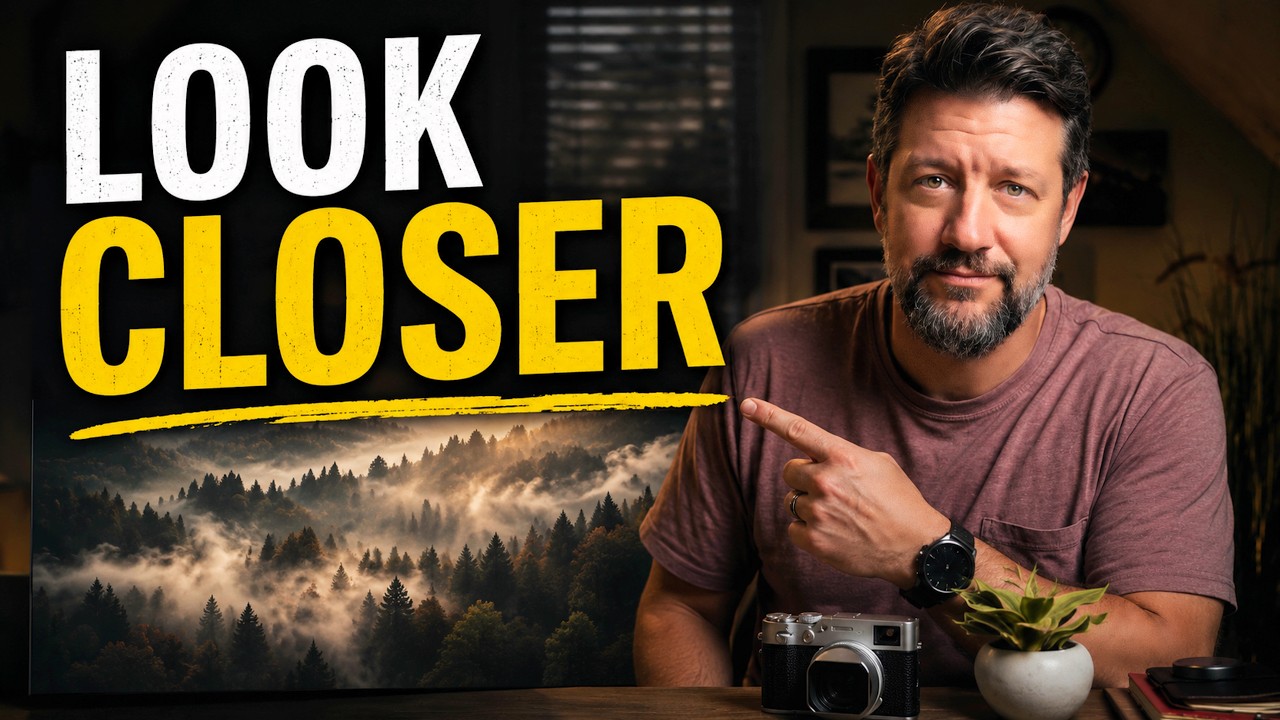
That feeling nagged at me for weeks. Then I watched Mark Denney work through it in his video, “You Slowly Stop Seeing This.”
It named something I’d been carrying around without a label.
The Creative Hangover Nobody Talks About
Denney describes returning to the Great Smoky Mountains after shooting Patagonia, one of the most visually overwhelming places on earth. What he found himself feeling wasn’t gratitude for being back somewhere familiar and beautiful. It was a kind of visual flatness. The quiet fog in the trees, the diffused light, the small intimate scenes he’d spent years learning to love suddenly felt insufficient.
That’s the trap he’s identifying. Dramatic conditions are genuinely addictive. Your nervous system responds to a firehose of color and scale, and after a while that becomes the baseline. Anything quieter registers as a creative dead zone instead of what it actually is: a different vocabulary.
I’ve watched this happen to photographers in my workshops. They come in having spent the summer chasing the American West. Arches, Grand Teton, Maroon Bells. By September, they’re standing in a perfectly beautiful old-growth forest and they’re bored. They’re not lazy or untalented. Their eyes have just been recalibrated toward scale.
How Social Media Rewires What You See in the Field
Denney makes a point here that I think deserves more weight than people usually give it. Social media doesn’t just change what you share. It changes what you notice in the field before you ever lift the camera. When you’ve spent months consuming images that consistently reward drama, contrast, and peak conditions, you start unconsciously filtering your environment through that same lens before you even set up a shot.
You stop in front of a misty hillside and the first thing your brain does is compare it to your feed. It doesn’t win that comparison. So you walk past it.
The mechanism he’s describing is real and measurable in your own behavior. Go back through your last three months of images and look at what you didn’t bring home. The scenes you scouted and dismissed. I did this exercise after watching the video, and I found two or three locations I’d written off as “not much happening” that I now want to revisit in completely different light.
Slowing Down as an Active Technique, Not a Platitude
Here’s where Denney gets practical in a way I appreciate. He’s not just saying “slow down and appreciate the small stuff.” He’s describing a specific shift in how you move through a location.
The approach: arrive at a scene and resist the urge to immediately identify the shot. Instead, spend the first ten to fifteen minutes just moving. Walk the edge. Look back the way you came. Kneel down. The goal is to break the habit of scanning for the obvious anchor point, which is almost always the biggest, brightest, or most dramatic element in the frame.
He also talks about actively looking for constraint. Instead of trying to include the whole scene, ask what happens if you isolate just one element. A single tree in fog. Light falling on a patch of lichen. This works because quiet scenes often don’t have a strong singular subject. They have mood and texture distributed across the frame, and the photographer’s job is to find the contained version of that.
I’ve been doing a version of this for years without fully articulating it. My mentor once told me the mountain doesn’t care about your schedule, meaning you can’t force a scene to reveal itself on your timeline. But Denney’s framing gives that idea a practical structure: give the scene a specific amount of deliberate looking time before you decide what it is or isn’t.
Where I’d Push Back Slightly
Denney’s video is aimed at the tendency to overlook subtle scenes. I agree with everything he says. But there’s a counter-pressure worth naming.
Not every quiet scene deserves a photograph. Part of the recalibration he’s describing can go too far in the other direction, where you start treating restraint itself as a creative virtue and reach for your camera in conditions that genuinely aren’t there. I’ve watched photographers exhaust themselves trying to find the intimate composition in a scene that simply doesn’t have one on that particular day.
The skill isn’t seeing everything as photographable. It’s increasing your sensitivity to the actual signal in quieter conditions without manufacturing signal that isn’t there. That distinction matters, especially if you’re making work for print or for an audience that will live with these images on a wall.
I still occasionally shoot film alongside digital for exactly this reason. When you have twelve frames on a roll, you become ruthlessly honest about whether something is actually worth it.
The Eye You Had Before You Knew What Epic Was
The single most useful thing Denney says is essentially this: the ability to see quiet, subtle moments was probably the thing that drew most of us to landscape photography in the first place. Before we knew what golden hour was supposed to look like. Before we had a feed full of reference images telling us what a good photograph should be.
That original eye isn’t gone. It just needs quieter conditions to operate in, and it needs you to stop flooding it with signal long enough to hear what it’s saying.
Watch the full video to see how Denney works through this in the field and in post. The editing section alone, where he shows how to handle subtle light and atmosphere in a RAW file without overworking it, is worth your time.
Comments (2)
Great breakdown. The step-by-step approach really helps.
Finally someone explains this in a way that actually makes sense.
Leave a Comment