
There’s a particular kind of panic that hits when you’re standing in front of something magnificent and you know the light is about to go. I’ve felt it hundreds of times over twenty years of doing this work. Your hands move faster than your brain, you grab a composition that feels safe, and you fire off fifty nearly identical frames. You drive home thinking you nailed it. You open the files and feel that slow deflation. Safe isn’t the same as good.
That’s exactly the failure mode that photographer William Patino addresses in his mountain sunset tutorial, shot above Dusky Sound in the remote southwest of Fiordland, New Zealand. Watch the full tutorial on YouTube and you’ll see someone working through a real location in real light, sharing the actual thought process rather than a polished-after-the-fact breakdown. What struck me watching it was how directly it challenged the habit most of us developed early on, the habit of locking in a composition hours before the light arrives. I’ve taught that bad habit in workshops myself without realizing it. This tutorial gave me language for a better approach.
The location is dramatic, windswept trees, a wide fiord valley, mountain peaks as a backdrop, but the techniques Patino walks through apply anywhere you’re working against a moving sky with limited time.
Step 1: Arrive Early, But Don’t Lock In
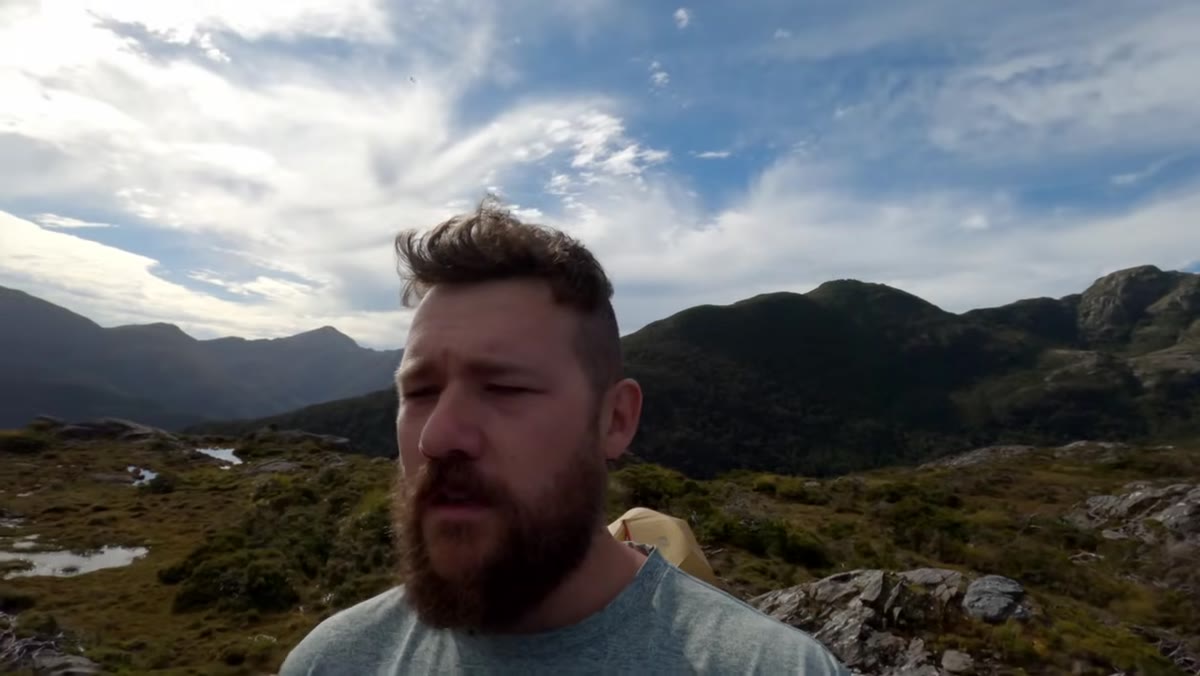
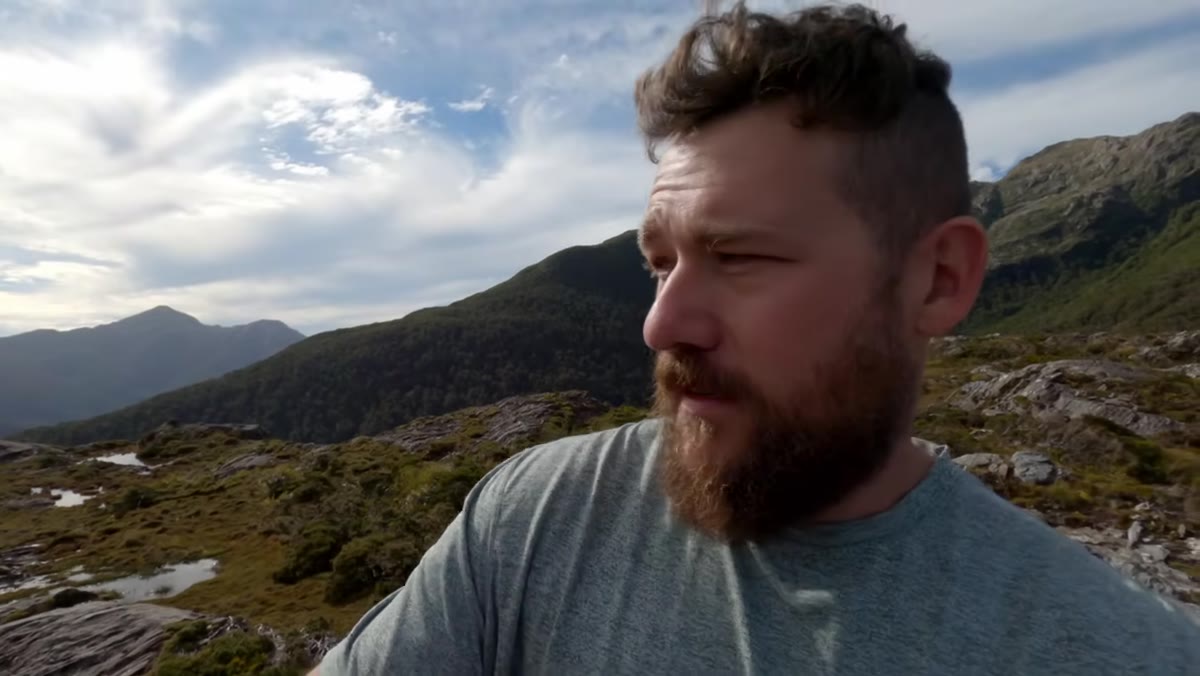 Photographer at camp, Dusky Sound panorama behind him
Get to your location with time to spare, at least two hours before the color arrives. Use that buffer to walk the area without your tripod. Look at the peaks, the foreground textures, the direction the light will come from. Note two or three potential anchor points. But here’s the discipline: don’t set up yet. Don’t commit. The point of arriving early is reconnaissance, not premature commitment. The moment you plant your tripod and call it done, you’ve stopped seeing.
Photographer at camp, Dusky Sound panorama behind him
Get to your location with time to spare, at least two hours before the color arrives. Use that buffer to walk the area without your tripod. Look at the peaks, the foreground textures, the direction the light will come from. Note two or three potential anchor points. But here’s the discipline: don’t set up yet. Don’t commit. The point of arriving early is reconnaissance, not premature commitment. The moment you plant your tripod and call it done, you’ve stopped seeing.
I used to front-load all my creative decision-making the instant I arrived at a location. By the time the light got interesting, I was already mentally checked out, just waiting for my predetermined shot. Patino’s approach flips that. Arrive early, explore freely, then let the light tell you where to stand.
Step 2: Let Emotional Response Drive Composition
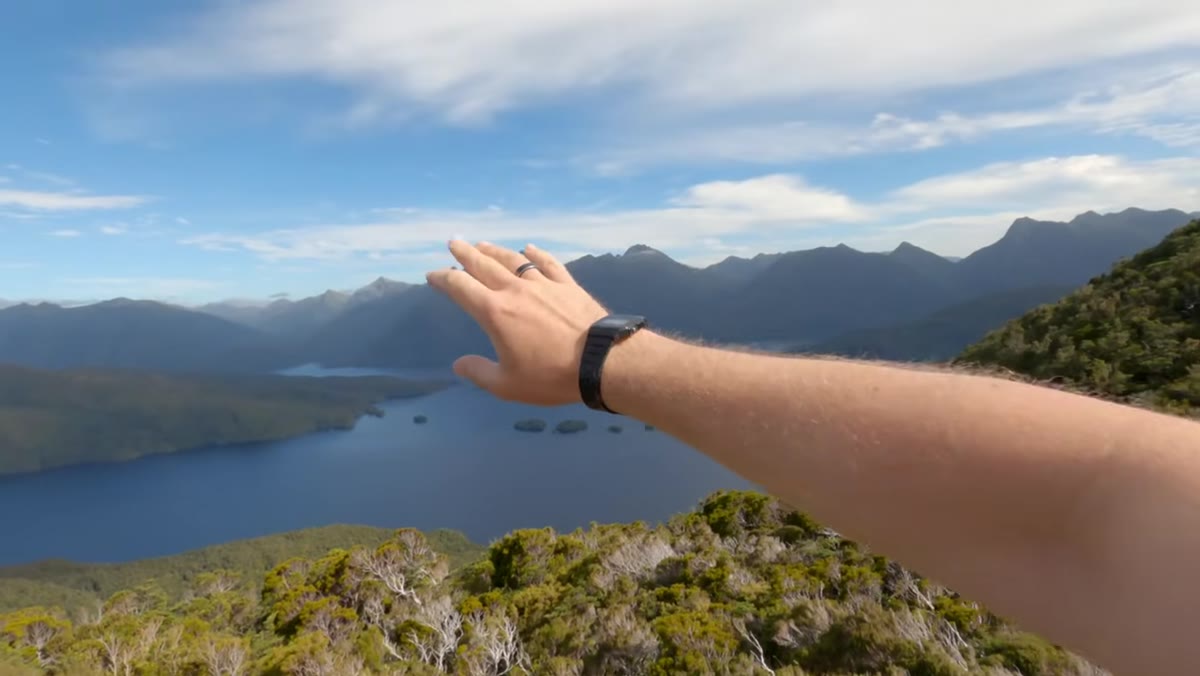 Wide establishing shot looking over Dusky Sound with peaks visible
When Patino describes what draws him to a particular vantage point, he talks about emotional response first, technical justification second. He’s drawn to the horizontal windswept trees because they have character. He looks at the mountain peaks as a strong main subject. He notices the curvature of the fiord and thinks about going ultra-wide to capture it. None of that is a calculation. It’s a feeling, and he trusts it.
Wide establishing shot looking over Dusky Sound with peaks visible
When Patino describes what draws him to a particular vantage point, he talks about emotional response first, technical justification second. He’s drawn to the horizontal windswept trees because they have character. He looks at the mountain peaks as a strong main subject. He notices the curvature of the fiord and thinks about going ultra-wide to capture it. None of that is a calculation. It’s a feeling, and he trusts it.
Ask yourself what made you go to this location in the first place. What moved you when you first looked at the scene? That initial emotional hit is data. It tells you something about where your strongest image lives. Composition that begins with feeling tends to communicate feeling. Composition that begins with rule-checking tends to look like a diagram.
Step 3: Resist the Urge to Pre-Plan Everything
 Patino walking the location, not yet set up on tripod
This is the step that will feel the most uncomfortable, especially if you’re like I was in my first decade of shooting. Patino is direct about it: he used to pre-plan obsessively, find the shot early, set up, wait, and execute. He came home with technically fine images that felt flat. The problem was that he’d made all his creative decisions before the scene had anything interesting to say.
Patino walking the location, not yet set up on tripod
This is the step that will feel the most uncomfortable, especially if you’re like I was in my first decade of shooting. Patino is direct about it: he used to pre-plan obsessively, find the shot early, set up, wait, and execute. He came home with technically fine images that felt flat. The problem was that he’d made all his creative decisions before the scene had anything interesting to say.
His recommendation now is to hold off on finding the composition until the light starts to shift. Yes, that feels like walking a tightrope. Yes, you’ll feel the anxiety rising as the color starts to build and you’re still not set up. That anxiety is actually useful, it sharpens attention. The goal is to stay calm inside that discomfort long enough for the scene to show you what it wants to be.
Step 4: Move, Watch, and Work in Short Bursts
 Patino moving between positions, evaluating the scene handheld
Patino’s field rhythm is deliberate but mobile. He’s not running around chasing the light. He moves to a spot, takes a frame or two, evaluates, and moves on. He describes it as a kind of childlike curiosity, you’re not hunting for confirmation of your existing idea, you’re genuinely open to finding something you didn’t expect.
Patino moving between positions, evaluating the scene handheld
Patino’s field rhythm is deliberate but mobile. He’s not running around chasing the light. He moves to a spot, takes a frame or two, evaluates, and moves on. He describes it as a kind of childlike curiosity, you’re not hunting for confirmation of your existing idea, you’re genuinely open to finding something you didn’t expect.
This works equally well with a tripod if you’re disciplined about picking it up and relocating rather than treating it as an anchor. The trap with a tripod is that it becomes a psychological commitment. Once it’s down, most photographers stop exploring. Fight that. Think of the tripod as a tool you deploy for a specific shot once you’ve earned the composition by moving.
Step 5: React to the Light, Don’t Chase the Plan
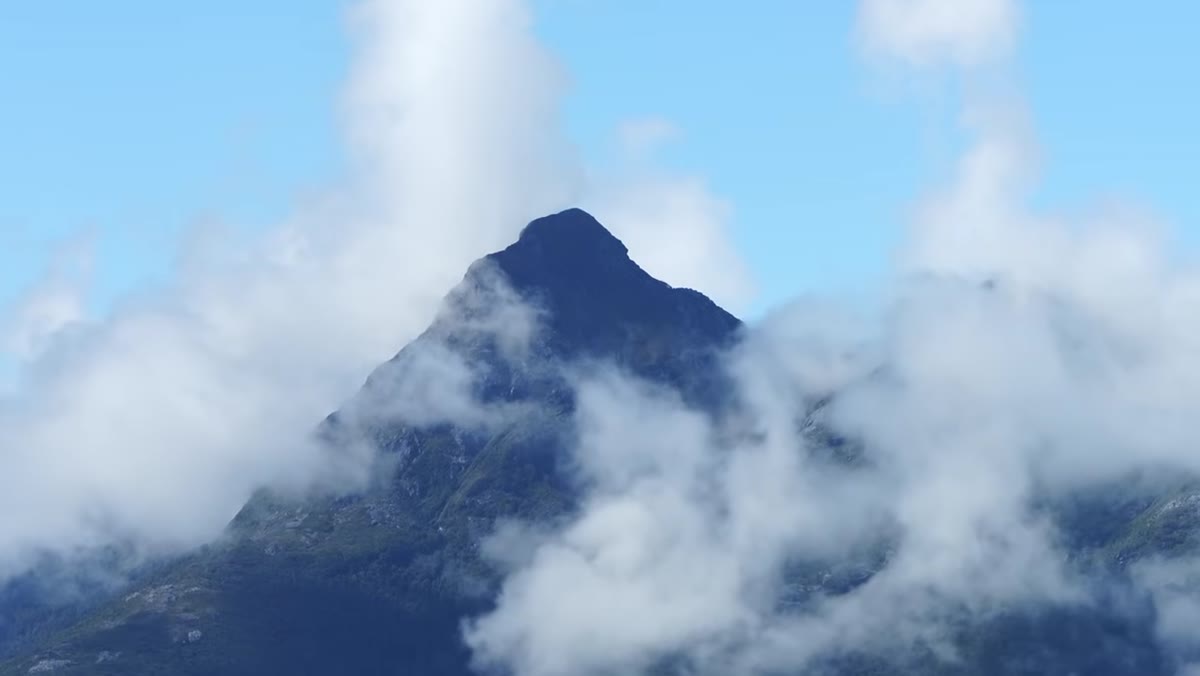
 Sky beginning to shift color over Fiordland peaks
When the light starts moving, your job is observation first, camera second. Watch what the sky is doing. Notice where the warmth is falling on the landscape. Let the scene evolve for a moment before you fire. Patino talks about wanting to get into a flow state, that quality of absorbed, reactive attention where you’re not second-guessing every decision but responding instinctively.
Sky beginning to shift color over Fiordland peaks
When the light starts moving, your job is observation first, camera second. Watch what the sky is doing. Notice where the warmth is falling on the landscape. Let the scene evolve for a moment before you fire. Patino talks about wanting to get into a flow state, that quality of absorbed, reactive attention where you’re not second-guessing every decision but responding instinctively.
That flow state is accessible, but only if you haven’t spent the last two hours grinding your creative gears down to a nub with over-planning. It arrives when you’re inspired and present. The pre-scouting you did earlier gives you just enough orientation to move confidently without having to think about logistics during the moments that matter.
Step 6: Shoot, Review, Select With Intention
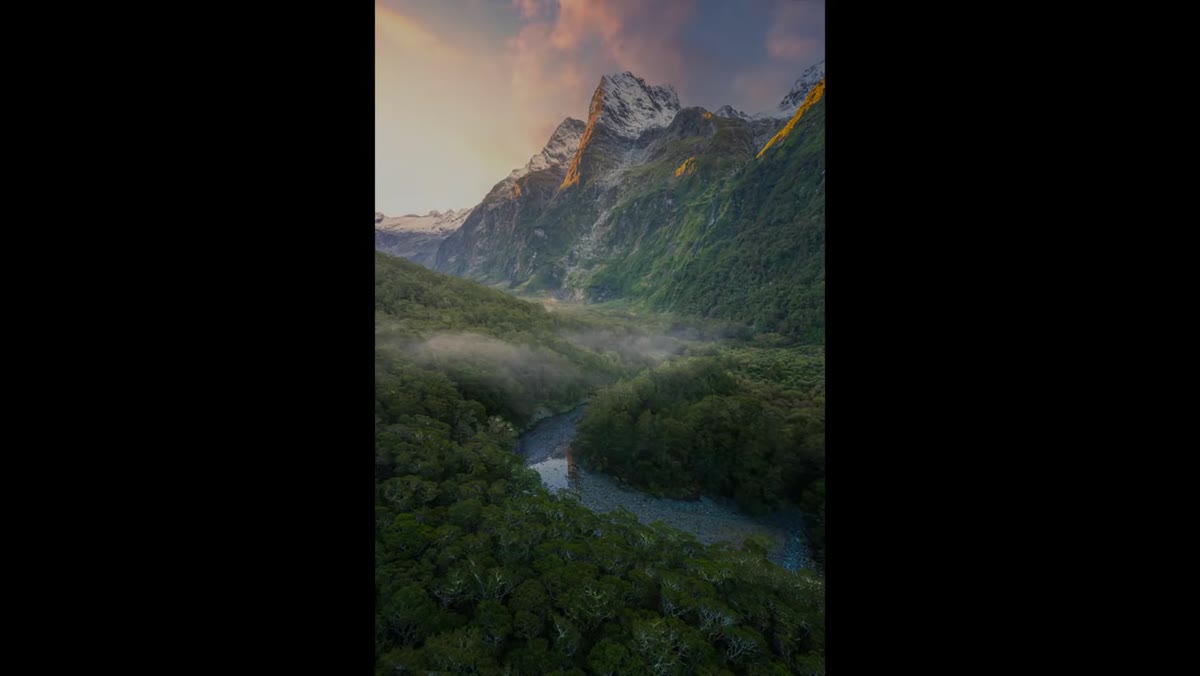
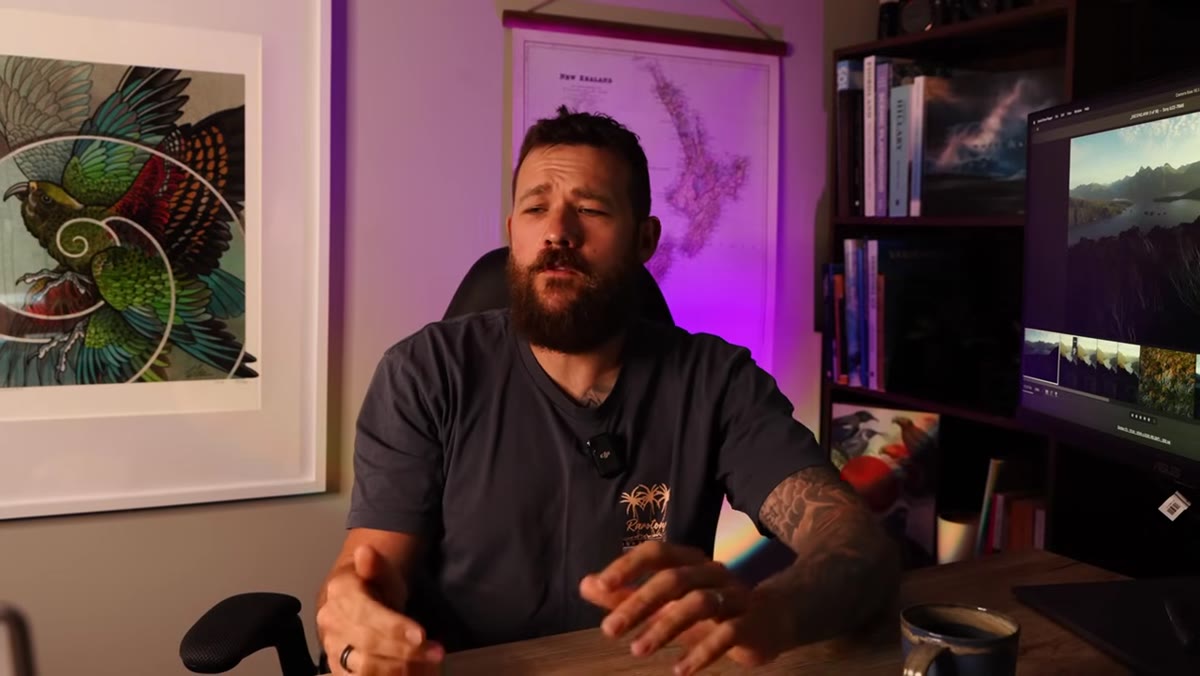 Patino reviewing raw files back at camp post-shoot
After the shoot, Patino goes back through his raw files with a clear selection process in mind. He’s not just keeping the technically sharpest frame. He’s asking what image best captures the light, best serves the composition, best communicates the emotion of that evening. Image selection is a creative act, not a quality-control pass.
Patino reviewing raw files back at camp post-shoot
After the shoot, Patino goes back through his raw files with a clear selection process in mind. He’s not just keeping the technically sharpest frame. He’s asking what image best captures the light, best serves the composition, best communicates the emotion of that evening. Image selection is a creative act, not a quality-control pass.
Give yourself at least one full day between shooting and selecting. The adrenaline of a good sunset warps your judgment. Come back to the files with fresh eyes and ask which single image you’d print large and put on a wall. That question cuts through the noise fast.
What I’d Add From Twenty Years in the Field
The mentor who mattered most to me once said something that took years to fully land: the mountain doesn’t care about your schedule. You can plan everything perfectly, drive for hours, hike to an ideal vantage point, and the clouds will do whatever they want. The light will arrive differently than you imagined. The scene will demand something from you that you didn’t prepare for.
What Patino is really teaching isn’t a technique. It’s a posture. Stay open. Stay mobile. Don’t decide too early. I still wear the same beat-up hat on every shoot, a small ritual that reminds me I’m showing up to witness something, not to execute a plan. The shots that have mattered most in my career, the ones that became prints that sell, came from moments when I let go of what I expected and paid attention to what was actually happening in front of me. That’s the practice Patino is modeling above Dusky Sound, and it’s worth watching more than once.
The single most important thing this tutorial teaches is deceptively simple: don’t find your composition until the light gets good. Everything else follows from that.
Watch the full tutorial on YouTube and pay attention to how calm Patino is when the color starts to build. That calm is the skill.
Comments (2)
Just subscribed. If the rest of your content is this good, I'm in.
Quality content like this is rare. Keep it up.
Leave a Comment