
Every time I come back from a long shoot, I face the same problem. Last autumn I drove out to the Alvord Desert and spent four days chasing light across the playa. I came home with just over 900 raw files. I sat down at my desk, opened Lightroom, and felt that familiar dread settle in. Not because editing is hard, but because I genuinely didn’t know where to start. Which images even deserved my attention? Spending weeks slogging through mediocre frames hunting for the two or three that matter is a real cost, and most photographers I know don’t have a repeatable system for avoiding it.
That’s what made this Mark Denney tutorial land so well for me. Watch the full tutorial on YouTube — he walks through a real, unreviewed batch of Iceland workshop images and applies a simple three-element filter that tells him almost instantly whether a photo is worth his time. The framework isn’t complicated. But having it explicit, as a checklist rather than a vague intuition, changes how fast and how confidently you move through a library. Here’s how it works in practice.
Step 1: Load Your Images Without Culling First
 Lightroom library grid showing unreviewed Iceland images loaded fresh
Resist the urge to start deleting the obvious misses before you’ve done a proper pass. Denney loads his entire trip’s worth of images, makes no preliminary judgments, and scrolls through with a clear framework in mind. The reason this matters is that your brain is different after a long trip. You’re tired, you’re emotionally attached to certain moments, and you’ll either over-cull from exhaustion or under-cull because everything feels significant. Starting with a structured lens rather than raw feeling keeps the process honest.
Lightroom library grid showing unreviewed Iceland images loaded fresh
Resist the urge to start deleting the obvious misses before you’ve done a proper pass. Denney loads his entire trip’s worth of images, makes no preliminary judgments, and scrolls through with a clear framework in mind. The reason this matters is that your brain is different after a long trip. You’re tired, you’re emotionally attached to certain moments, and you’ll either over-cull from exhaustion or under-cull because everything feels significant. Starting with a structured lens rather than raw feeling keeps the process honest.
Open your import in Library mode and set the view to a comfortable grid or loupe size. Don’t touch the reject flag yet. You’re not deleting. You’re evaluating.
Step 2: Ask Whether the Image Has a Strong Subject
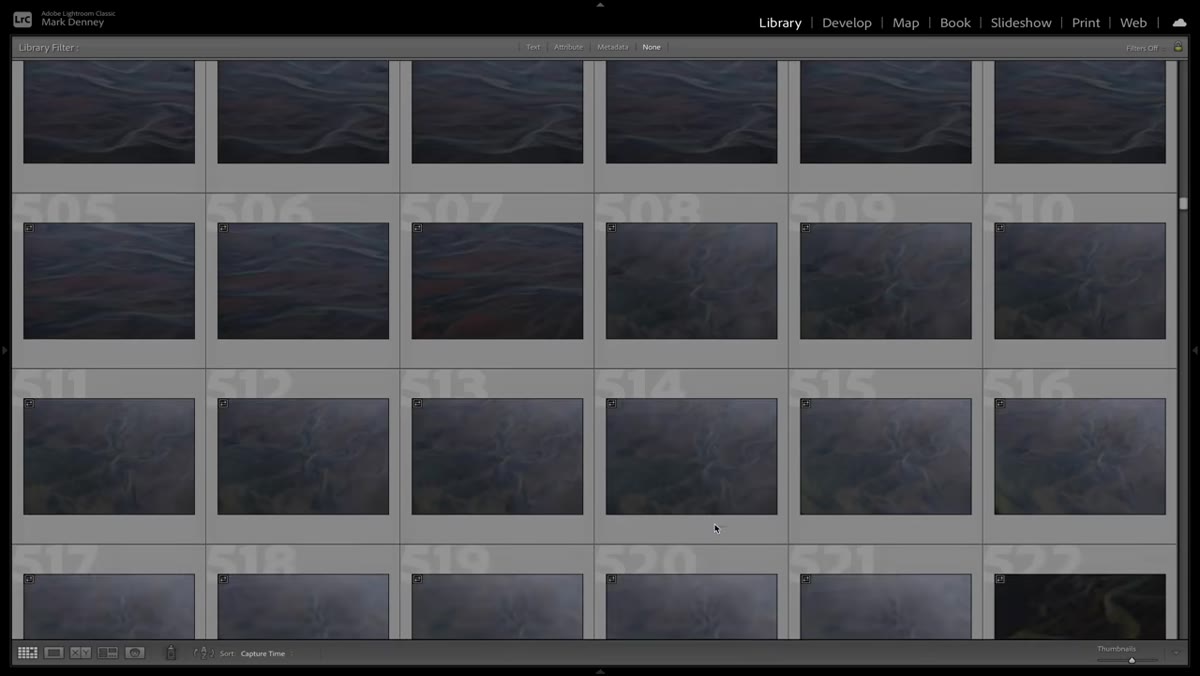
 Scrolling through braided river aerials in Lightroom grid view
This is the first of the three elements, and Denney treats it as the foundation. A strong subject doesn’t have to be literal or obvious. In the Iceland aerial shots he reviews, the subject is essentially color contrast: the black sand against aqua-toned water. The subject is the story the image tells at a glance. If you have to explain what someone should be looking at, you probably don’t have a strong subject.
Scrolling through braided river aerials in Lightroom grid view
This is the first of the three elements, and Denney treats it as the foundation. A strong subject doesn’t have to be literal or obvious. In the Iceland aerial shots he reviews, the subject is essentially color contrast: the black sand against aqua-toned water. The subject is the story the image tells at a glance. If you have to explain what someone should be looking at, you probably don’t have a strong subject.
When I’m moving through a library, I give each image about two seconds to answer the question: what is this photograph of? If the answer is clear and interesting, I stay. If I’m searching for it, I move on. A subject can be architectural, atmospheric, or abstract, but it has to exist. Fog banks and empty skies are not subjects. A lone pine silhouetted against a fog bank? That’s a subject.
Step 3: Evaluate Composition as a Separate Pass
 Close-up review of vertical aerial compositions in Lightroom loupe view
Composition is Denney’s second element, and he’s deliberate about separating it from subject evaluation rather than conflating the two. An image can have a compelling subject and still be composed poorly. He flags images where the framing amplifies the subject rather than competing with it, noting that simplicity in composition often does more work than complexity.
Close-up review of vertical aerial compositions in Lightroom loupe view
Composition is Denney’s second element, and he’s deliberate about separating it from subject evaluation rather than conflating the two. An image can have a compelling subject and still be composed poorly. He flags images where the framing amplifies the subject rather than competing with it, noting that simplicity in composition often does more work than complexity.
Look at how the frame is divided. Does the placement of your main element create tension or rest, whichever the image needs? Is there visual noise pulling the eye away from the subject? I’ve started mentally overlaying a simple question: if I cropped this to remove every element except the subject, would the remaining image be stronger? If the answer is yes too often, the original composition is working against itself.
Step 4: Check for Light Quality as the Third Element
 Reviewing color and tonal contrast across braided river images in grid
Light is the third element in Denney’s framework. He’s not necessarily looking for golden hour drama in every frame. He’s looking for light that does something specific: that separates tones, reveals texture, creates mood, or gives the image a quality that couldn’t exist at a different time of day. Flat, directionless light with no tonal variation is the version of light that produces forgettable images, no matter how good the subject or composition.
Reviewing color and tonal contrast across braided river images in grid
Light is the third element in Denney’s framework. He’s not necessarily looking for golden hour drama in every frame. He’s looking for light that does something specific: that separates tones, reveals texture, creates mood, or gives the image a quality that couldn’t exist at a different time of day. Flat, directionless light with no tonal variation is the version of light that produces forgettable images, no matter how good the subject or composition.
In practice, I scan for shadow detail and highlight separation before I even think about exposure correction. A well-lit image has inherent contrast and depth. You can feel it even in a thumbnail. If I’m squinting at a grid image trying to decide if the light is interesting, it usually isn’t. Good light announces itself.
Step 5: Apply the “Two Out of Three” Rule Before Rating
 Applying five-star ratings to selected images in Lightroom
Here’s where the framework becomes actionable. Denney’s core insight is this: a great landscape photograph doesn’t need all three elements. It needs two. An image with extraordinary light and a strong subject can carry a simple composition. An image with a stunning subject and excellent composition can survive unremarkable light. But an image with only one element working, no matter how strong that one element is, rarely makes the cut.
Applying five-star ratings to selected images in Lightroom
Here’s where the framework becomes actionable. Denney’s core insight is this: a great landscape photograph doesn’t need all three elements. It needs two. An image with extraordinary light and a strong subject can carry a simple composition. An image with a stunning subject and excellent composition can survive unremarkable light. But an image with only one element working, no matter how strong that one element is, rarely makes the cut.
As you review each image, mentally note which elements are present. Two or more? Rate it five stars, as Denney does, and move on immediately. He uses a binary system: either nothing or five stars, which keeps the workflow fast. One element or fewer? Pass without flagging and keep scrolling. This single discipline will compress a multi-week culling process into a focused session.
Step 6: Move Through the Library at Speed Without Second-Guessing
 Fast scrolling through full library with decisive ratings applied
The final piece of Denney’s workflow is tempo. He moves quickly, trusting the framework rather than agonizing over edge cases. When you have a repeatable filter, speed is appropriate. You’re not making final decisions about the images yet. You’re triaging. The five-star images will go through rounds of closer review later. At this stage, decisive movement through the library protects you from decision fatigue and from falling in love with images that don’t deserve it.
Fast scrolling through full library with decisive ratings applied
The final piece of Denney’s workflow is tempo. He moves quickly, trusting the framework rather than agonizing over edge cases. When you have a repeatable filter, speed is appropriate. You’re not making final decisions about the images yet. You’re triaging. The five-star images will go through rounds of closer review later. At this stage, decisive movement through the library protects you from decision fatigue and from falling in love with images that don’t deserve it.
Set a rule for yourself: no image gets more than five seconds during the initial pass unless something genuinely stops you. If you’re spending 30 seconds debating a single frame at this stage, the answer is almost always that it doesn’t have two elements working strongly enough.
A Field Note From 20 Years of Coming Home Tired
My mentor once told me that the mountain doesn’t care about your schedule, and I’ve extended that idea to editing: the image doesn’t care how far you drove to get it. I’ve driven six hours to a location, sat in fog for two days, and come home with a single usable frame that became my best-selling print. I’ve also shot hundreds of frames in perfect golden light and kept maybe four. The distance or the effort has nothing to do with whether the elements came together.
What Denney’s framework does is remove the sentimental weight from culling. You’re not judging the experience or the effort. You’re asking a cold, clear question about what’s in the frame: subject, composition, light. Two of three. The process gets faster and more accurate the more you apply it, because you start seeing those elements while you’re still in the field, before you ever open Lightroom.
The single most transferable idea here is the two-out-of-three rule. It’s simple enough to remember in the field, fast enough to apply during culling, and honest enough to override the emotional attachment that makes most photographers hold onto mediocre work for too long. Build the habit of evaluating those three elements on every frame, and your best images will start finding themselves.
Watch the full tutorial on YouTube to see Denney apply this in real time against his Iceland library, which makes the framework concrete in a way that’s worth watching at least once.
Comments (1)
I've watched a dozen tutorials on this and yours is the clearest by far.
Leave a Comment